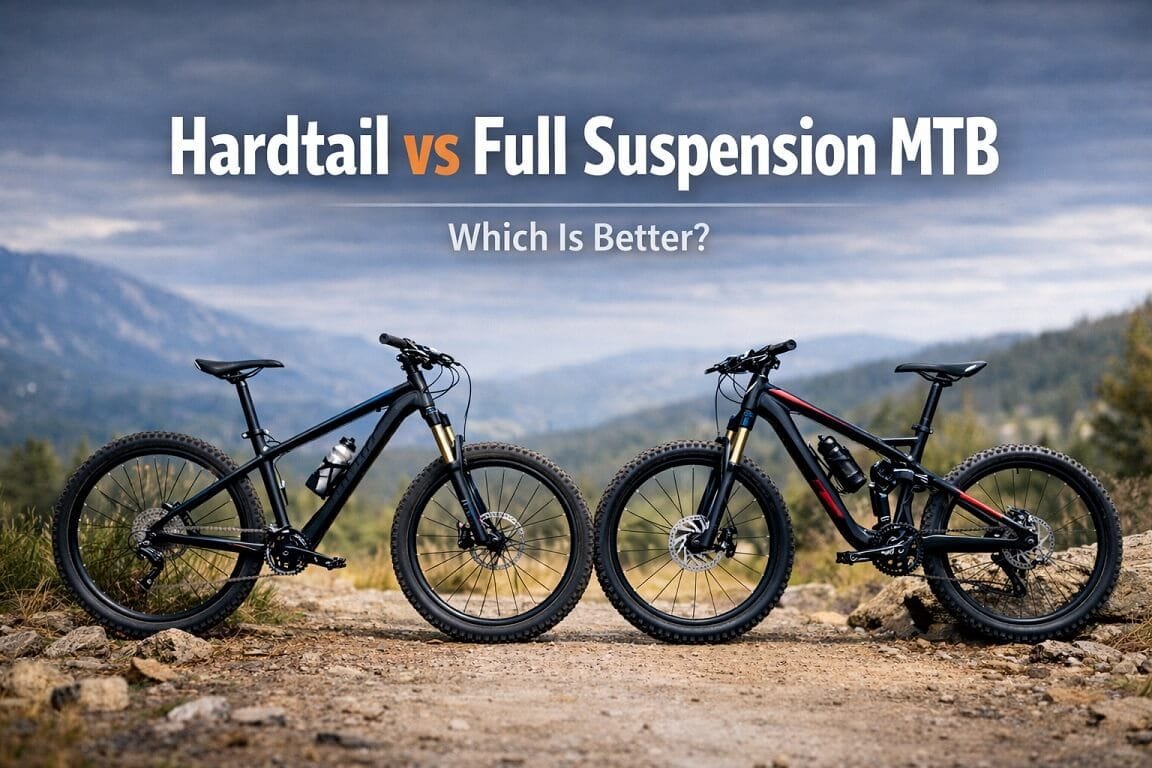
Hardtail vs Full Suspension MTB: Which Is Better?

Choosing between a hardtail vs full suspension mountain bike is the biggest decision a rider can make. Whether you’re a beginner looking for your first ride or a veteran weighing a costly upgrade, the ‘right’ choice depends on your local trails and budget.
While hardtails are lighter, more affordable, and reward technical skill, full suspension bikes offer the comfort and traction needed to conquer rough, rocky terrain with confidence. This guide explains the real differences, trail performance, costs, and who each bike is best for—so you can make the right choice without confusion.
Quick Verdict: Hardtail or Full Suspension?
- Best for beginners: Hardtail
- Best for budget riders: Hardtail
- Best for smooth trails & XC: Hardtail
- Best for rough trails: Full suspension
- Best for comfort & control: Full suspension
- Best for aggressive riding: Full suspension
If trails are smooth and budget matters, a hardtail makes sense. If trails are rocky and comfort matters, full suspension wins.
What Is a Hardtail Mountain Bike?
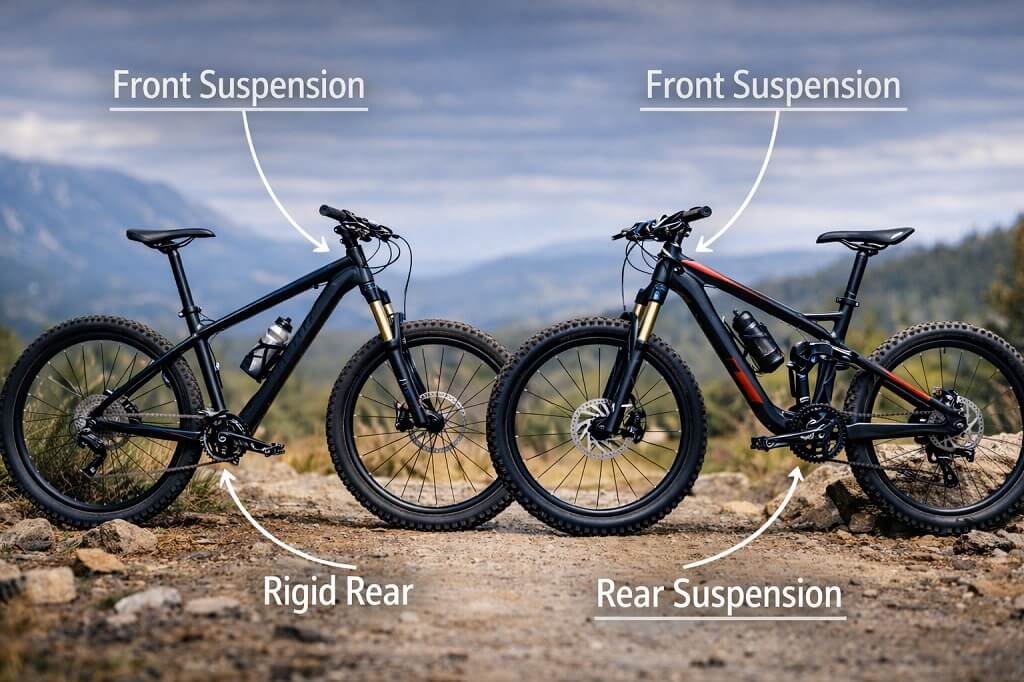
A hardtail mountain bike has front suspension only and a rigid rear frame. This simple design makes the bike lighter and more efficient, especially on climbs and smooth trails. Hardtails are popular with beginners because they are easy to maintain and cost less than full suspension bikes. They also help riders learn proper line choice and bike handling since there is less forgiveness from the rear end.
Most hardtails are used for cross-country riding, light trail riding, and fitness-focused cycling. Suspension travel usually ranges from 100mm to 130mm, depending on the bike’s purpose.
What Is a Full Suspension Mountain Bike?
A full suspension mountain bike has both front and rear suspension. The rear shock absorbs impacts from rocks, roots, and drops, keeping the rear wheel planted on the ground. This design improves traction, comfort, and control, especially on technical trails. Full suspension bikes are common in trail, enduro, and downhill riding.
Suspension travel varies widely:
- Trail bikes: 120–140mm
- Enduro bikes: 150–170mm
- Downhill bikes: 180mm+
The added complexity increases cost and maintenance, but the performance benefits are noticeable on rough terrain.
Hardtail vs Full Suspension: Key Differences
| Feature | Hardtail MTB | Full Suspension MTB |
| Suspension | Front only | Front + rear |
| Weight | Lighter | Heavier |
| Comfort | Moderate | High |
| Control on Rough Trails | Limited | Excellent |
| Climbing Efficiency | Very good | Slightly reduced |
| Descending Confidence | Lower | Much higher |
| Maintenance | Low | Higher |
| Price Range | More affordable | More expensive |
| Skill Development | Teaches technique | Forgiving |
Trail Performance Comparison
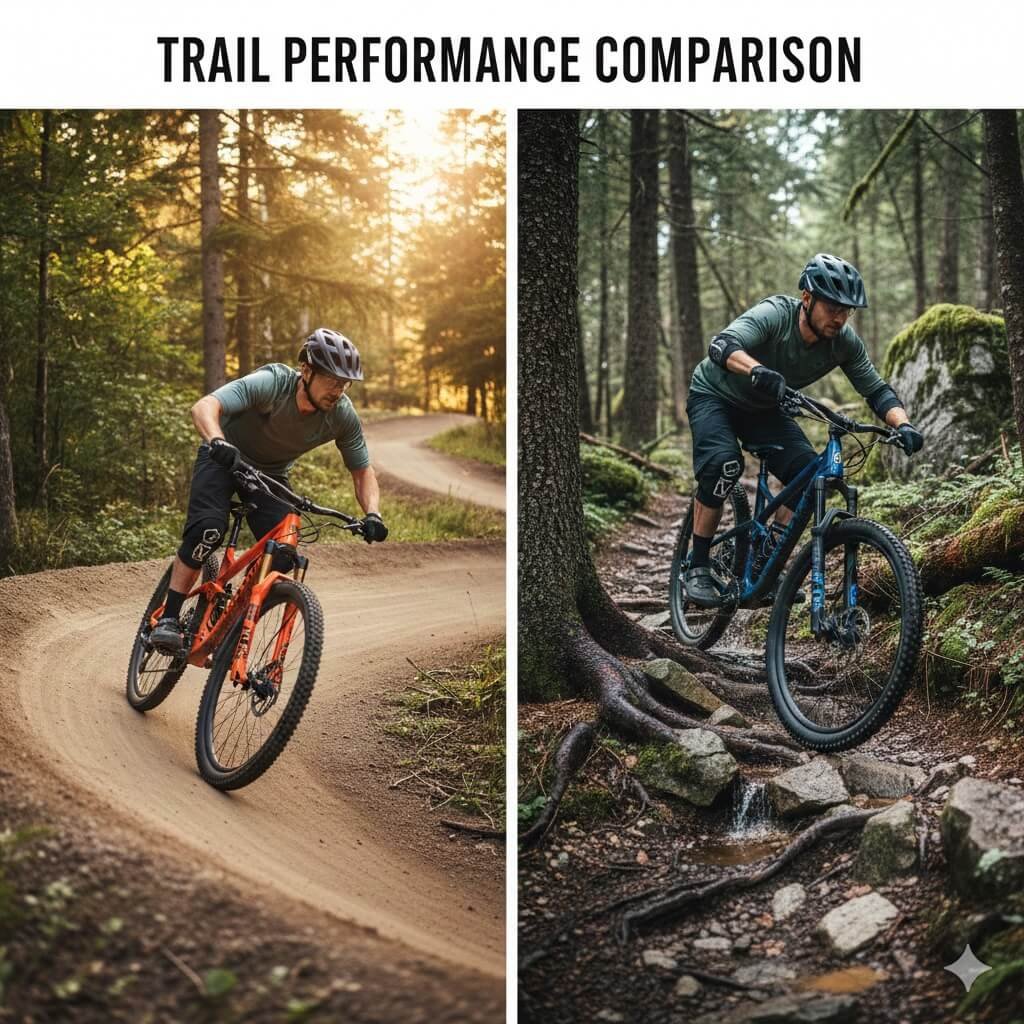
Choosing between a hardtail and full suspension mountain bike depends on your trails and riding style. Hardtails are efficient on smooth trails and climbs, while full suspension bikes excel on rough, rocky, or root-filled terrain for better control and comfort.
Smooth Trails
Hardtails feel fast and efficient on smooth trails. Less suspension means more power goes directly into forward motion. Full suspension bikes still perform well, but the advantage is smaller here.
Rocky Trails
Full suspension bikes shine on rocky terrain. The rear suspension absorbs impacts, keeps traction consistent, and reduces rider fatigue. Hardtails feel harsher and require careful line choice.
Root-Heavy Forest Trails
Roots can unsettle a hardtail quickly. Full suspension bikes track the ground better and provide more stability through uneven sections.
Long Climbs
Hardtails climb more efficiently because of lower weight and less energy loss. Full suspension bikes climb well but may feel slower unless properly tuned.
Descents
Full suspension bikes offer far more confidence downhill. Hardtails demand precision and experience, especially at speed.
Comfort, Control, and Rider Fatigue
Comfort becomes important on longer rides. Hardtails transfer more trail vibration to the rider, which can lead to arm, shoulder, and lower back fatigue over time.
Full suspension bikes reduce trail chatter and absorb repeated impacts. This helps riders stay fresher for longer rides and maintain control late into the ride. For riders with back sensitivity or who ride rough trails often, full suspension provides a noticeable comfort advantage.
Skill Progression: Which Bike Makes You Better?
Hardtails force riders to develop good habits. You learn to pick clean lines, maintain balance, and manage speed. Many experienced riders believe that starting on a hardtail builds stronger fundamentals.
Full suspension bikes are more forgiving. They allow riders to make small mistakes without immediate consequences. This can boost confidence but may slow technical skill development early on.
Both bikes help you improve, but they do it differently.
Maintenance, Durability, and Long-Term Costs
Hardtails are simple. Fewer moving parts mean:
- Less maintenance
- Lower service costs
- Fewer mechanical issues
Full suspension bikes require:
- Rear shock servicing
- Pivot bearing maintenance
- More frequent inspections
Over several years, ownership costs are higher for full suspension bikes, especially if ridden often.
Price and Value Comparison
- Entry-level: Hardtails offer better components for the price
- Mid-range: The gap narrows, but hardtails still provide strong value
- High-end: Full suspension performance justifies the cost for aggressive riders
If budget is limited, a quality hardtail usually outperforms a cheap full suspension bike.
Which One Should You Choose?
Choose a Hardtail If:
- You are new to mountain biking
- Trails are smooth to moderate
- Budget matters
- You want low maintenance
- You value climbing efficiency
Choose a Full Suspension If:
- Trails are rocky or technical
- Comfort matters on long rides
- You ride aggressively
- You want more downhill confidence
- You plan to progress into harder terrain
Common Mountain Bike Myths – Hardtail vs Full Suspension
Myth 1: Hardtails are only for beginners
False. Experienced riders often choose hardtail mountain bikes to improve fitness and technical skills. They’re lightweight, simple, and great for trail control.
Myth 2: Full suspension bikes are always slower
False. On rocky or technical trails, full suspension bikes often ride faster and provide better control than hardtails.
Myth 3: Hardtails will hurt your back
False. Back comfort depends more on proper bike fit, riding posture, and trail selection than on suspension type.
Frequently Asked Questions – Hardtail vs Full Suspension Mountain Bikes
Which is better for beginners: hardtail or full suspension MTB?
Hardtail mountain bikes are ideal for beginners. They cost less, are easier to maintain, and help improve riding skills on smooth trails.
Are hardtail bikes faster than full suspension bikes?
On smooth trails and uphill climbs, hardtails are faster because of their lighter weight. On rough, technical trails, full suspension bikes provide better speed and control.
Is a full suspension mountain bike worth the extra cost?
Full suspension bikes are worth the investment if you ride rocky or technical trails often. They offer superior comfort, shock absorption, and control.
Which MTB is better for trail riding?
For smooth trails, a hardtail performs well. For rough, rocky, or root-heavy trails, a full suspension mountain bike is the better choice for comfort and handling.