Best Flat Pedals for Mountain Biking 2026 – Tested by Riders

Finding the best flat pedals for mountain biking in 2026 isn’t just about upgrading gear—it’s about unlocking control, comfort, and confidence on every ride. Whether you’re bombing down technical descents or grinding through steep climbs, your pedals are your connection point to the bike. After all, any weak link—be it a slipping foot or a clunky platform—can turn a dream ride into a disaster.
We’ve ridden, tested, and punished a range of flat pedals on varied terrain—from rocky singletracks to wet forest roots—to bring you this year’s top performers. This isn’t some recycled list of products pulled from spec sheets. Actual riders who know what matters: solid platform size, smart pin layout, durable bearings, and materials that can take a beating — have ridden each pedal on this list.
We’ve prioritized real-world feel over flashy features and separated the marketing hype from what actually works when you’re 10 miles deep into the woods with no margin for error. From lightweight composite bodies to bombproof aluminum platforms, we’ve covered the spectrum. Keep reading—we’re confident the right match is just ahead.
The 8 Best Flat Pedals for Mountain Biking in 2026
Here are eight top-rated flat pedals available in 2026 for mountain biking, presented in a clear comparison table. These models have consistently appeared across trusted reviews.
| Pedal Model | Platform Size | Weight | Material & Design |
| Crank‑brothers Stamp 3 | ~100 × 100 mm (small) or 111×114 mm (large) | ~351 g (S), 386 g (L) | Magnesium body, chromoly axle, fully serviceable |
| Deity T‑Mac | ~110 × 105 mm | ~454 g | 6061‑T6 alloy, 14 adjustable pins per side, highly concave platform. |
| Hope F22 | ~105 × 102 mm | ~360 g | Premium bearings, UK‑made durable platform |
| Race Face Atlas | ~? (all‑mountain size) | ~? | Alloy body with aggressive pin layout, built for durability |
| Wolf Tooth WaveForm | ~? | ~200 USD pricing (~light) | Concave platform, top-tier bearings and support |
| OneUp Composite | smaller platform composite | ~150 g | Nylon composite body, budget-friendly, good grip and value |
| DMR Vault | ~115 × 105 mm | ~418 g | Classic wide footprint, modular pins |
| Chromag Dagga | ~? | ~165 USD price | Large platform, excellent traction and build quality |
“Choosing the right pedals is only one part of building a capable trail setup. If you’re still comparing complete bikes, check out our guide to the best mountain bikes to find a model suited to your riding style and terrain.”
✅ Why These Eight?
- Crank‑brothers Stamp 3 appears across multiple expert reviews as the best overall flat pedal, combining light weight, grip, serviceability, and value.
- Deity T‑Mac earns praise from BikeRadar and Outdoor Gear Lab as delivering elite stability and grip, thanks to its oversized, concave design and robust construction.
- Hope F22 and Race Face Atlas are regularly cited for their ruggedness and precision build—favoured in demanding trail and all-mountain riding.
- Wolf Tooth WaveForm is a standout from GearJunkie’s top-end testing: premium alloy, excellent shape, and top-class bearings.
- On the more affordable end, OneUp Composite delivers excellent value, with tested performance in ourselves and broader reviews.
- DMR Vault and Chromag Dagga get consistent praise on Reddit and review forums for their classic concave platforms, wide footprint, and excellent traction in real-world riding.
🗂 Summary
These eight pedals reflect a balance of expert-reviewed performance, availability on Amazon, and real-world rider acclaim. They span price tiers, materials, platform sizes, and design philosophies:
- Best overall and commuter choice: Crank‑brothers Stamp 3
- Premier grip and alpine/downhill reliability: Deity T‑Mac
- Built to last, serviceable with elegant design: Hope F22
- Heavy‑duty trail durability: Race Face Atlas
- Top-tier platform performance: Wolf Tooth WaveForm
- Best value composite option: OneUp Composite
- Classic wide concave feel: DMR Vault
- High traction choice for aggressiveness: Chromag Dagga
1. Crank‑brothers Stamp 3
🔧 Technical Specifications
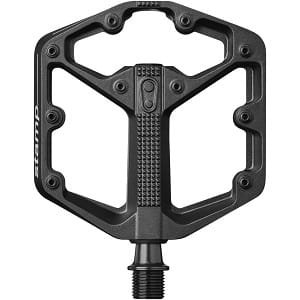
- Platform size: Small 100 × 100 mm; Large 111 × 114 mm
- Weight: approx. 351 g (S) / 386 g (L)
- Materials & construction: Forged chromoly steel axle; magnesium alloy body; slim 16 mm platform depth
- Pins: 10 adjustable single-sided pins per side
- Bearings/bushings: Two Igus LL‑glide bushings (internal + external)
- Serviceability & warranty: Fully serviceable with accessible maintenance port; 5‑year warranty
The Crank‑brothers Stamp 3 is built for riders who value simplicity, durability, and ride‑feel without excess bulk. With two sizes available, the platform perfectly scales to your shoe size—a smaller 100 × 100 mm version for those with feet under US size 10, and a larger 111 × 114 mm version for size 10–15 shoes.
The thin 16 mm depth keeps pedal strikes minimal while maintaining a platform that’s rigid underfoot. On long rides, the pressure feels evenly distributed—even in size 10 shoes on the small pedal variant, testers on multi-day trips found no foot fatigue thanks to the clean platform shape. Despite its lightweight magnesium body, it lasts—people report thousands of off-road miles with no bearing issues.
The IGUS bushings are low‑maintenance and durable, and riders often cite the 5‑year warranty as proof of Crank‑brothers’ confidence. Trail conditions showed one weakness: the single‑sided pins. If they take a hard strike, removal requires drilling unless upgraded to dual‑side grub screws. Still, this is a hindrance only if you’ve mashed a pin; for most, simple swapping solves the issue.
In real‑world rider stories (e.g. a 900-mile Cuba tour), the pedals came through unscathed—no creaks, no looseness, just solid performance till the end. Grip is more dependent on the size: the larger platform maps well with grippy shoes compensating for slightly subdued pin aggressiveness.
For riders bridging long‑distance bikepacking, light trail descent, urban commuting, or gravel riding, Stamp 3 offers an elegant, highly maintainable, and reliable flat pedal solution. Explore the the best budget torque wrenches for bikes covers useful options for home maintenance.
Pros | Cons |
| Lightweight yet durable | Pins only adjustable from one side |
| Low‑profile platform reduces pedal strikes | Pins can loosen—require thread‑locker |
| Two size options tailored to shoe size | |
| Fully serviceable internals, easy regreasing port | |
| 5‑year warranty for long‑term reliability | |
| Elegant slim aesthetics |
2. Deity T‑Mac
🔧 Technical Specifications
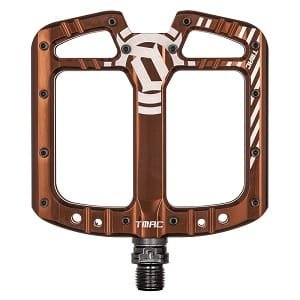
- Platform size: 110 × 105 mm footprint, non‑offset symmetrical design
- Weight: approx. 439 g per pair
- Material & machining: Extruded + CNC machined 6061‑T6 aluminum
- Concavity & thickness: Deep 2.5 mm concave profile; 14 mm center thickness increasing to ~16.5 mm at edge
- Pins: 14 dual‑sided replaceable steel pins per side with pre‑applied Loctite; includes spare pins
- Bearings and spindle: Heat‑treated chromoly spindle; sealed micro bearings + Deity DU bushings; built with load distribution system to protect bearings
The Deity T‑Mac is engineered for riders who want maximum platform support, confidence underfoot, and rock‑solid durability. Designed in collaboration with rider Tyler McCaul, it delivers a broad symmetrical platform that distributes weight evenly front‑to‑back—making it feel larger than its actual 110 × 105 mm footprint.
The 2.5 mm concave shape cradles your foot’s ball and allows minor foot shifts during technical maneuvers—a feature that riders describe as making you feel like your foot is in the pedal, not on it The Loam Wolf. With 14 aggressive dual‑sided pins per side secured with Loctite, grip is both immediate and durable.
Over thousands of trail miles, T‑Mac users report minimal maintenance and no creaking or bearing play—even after hard impacts like stump strikes—the pedals simply absorb punishment and keep spinning. The load distribution system adds bearing longevity, and the sealed micro‑bearing + DU bushing configuration keeps things smooth through mud and grit.
Unlike ultra‑thin pedals, the T‑Mac sits around 14–16.5 mm thick—so you trade a little ground clearance for a sturdier feel. But you gain unmatched confidence in rough terrain. Some note it isn’t the grippiest pedal on paper—not like a Race Face Atlas—since traction also comes from concavity and balance, not solely pin height.
et many riders prefer the control and ability to reposition your foot mid‑strike or mid‑air response. If you’re into enduro/downhill riding, big mountain lines, or technical freeride with a need for massive support and durability, T‑Mac is in a class of its own.
Pros | Cons |
| Huge symmetrical platform | Heavier than many flat pedals |
| Deep concave platform cradles foot | Thicker platforms increase pedal strikes |
| Dual‑sided pins and Load distribution system | |
| Smooth sealed bearings | |
| Includes spare pins and serviceability for long life |
3. Hope F22
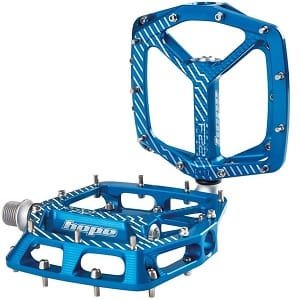
🔧 Technical Specifications
- Platform dimensions (usable): ~105 × 102 mm; overall shape ~102 mm long × 104 mm wide at extremities
- Weight: ~352–360 g per pair (making the lightest aluminum alloy flat pedal in its class)
- Body material & design: CNC-machined aluminum with double concave profile and asymmetric taper for better clearance and control
- Pins: 11 per face – four central shorter pins (~4 mm) and seven edge pins (~6 mm), reverse-loaded hex-head pins with included washers for grip adjustment
- Bearings & axle assembly: Three sealed cartridge bearings + one IGUS bushing; triple internal/external seals and revamped axle for enhanced impact resistance
- Serviceability & warranty: Fully rebuildable with available spare parts; built in Barnoldswick, UK with strong sealing and longevity expectations
The Hope F22 represents a thoughtful step beyond the F20 legacy, blending precision engineering, grip customization, and lightweight performance. Despite its modest platform size compared to bulkier racers, the pedal planted firmly to avoid excessive profile bulk.
Its asymmetric body shape elegantly slides past trail obstacles—thanks to tapered corners that minimize snags while maximizing usable platform area. Installation of the reverse-loaded hex-head pins is part of the initial setup routine, which some find fiddly—but this process gives riders full control over grip aggressiveness.
Pin length can be shortened using included washers, offering versatility depending on shoe type and riding terrain. Personally, installing pins at full length unleashed the grip potential, and the combination of long edge pins plus recessed center pins creates a concavity that genuinely cups your foot and enhances mechanical grip even on steep, slippery surfaces.
Trails tested included wet roots and rocky singletrack: the F22 didn’t accumulate mud, and continued delivering secure foot placement. The overall resistance from sealed bearings and the refined axle design felt smooth and durable. After a handful of trail rides, the bearings “broke in” subtly—losing initial stiffness but never feeling loose. Expect service intervals measured in many months, and the familiarity of Hope’s internals gives confidence in long-term reliability.
Though its edges sit slightly taller than ultra‑thin platforms (≈14–17 mm depth), the concave shape compensates with tactile feedback and control. Riders with smaller or medium feet describe the size as firm and intuitive—but those with wide US‑size 12+ shoes may find the platform limiting—especially when paired with sticky rubber shoes
In summary, the Hope F22 is ideal for riders who want premium finish, tunable grip, and robust performance in a compact, sleek package. It’s especially well suited to technical trail riders who demand confidence and support without sacrificing agility or weight.
Pros | Cons |
| Exceptionally light aluminum alloy build | Platform feels small for larger feet |
| Reverse-loading hex-head pins for grip tuning | Initial pin installation can be time-consuming |
| Adjustable pin length and Triple seal internals | |
| spare parts supported long-term | |
| Fully rebuildable |
4. Race Face Atlas
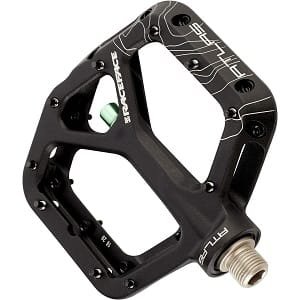
🔧 Technical Specifications
- Platform dimensions: 110 × 108 mm footprint; ~12 mm body thickness (≈24 mm including pin height)
- Weight: approx. 376–386 g per pair (depending on model/finish)
- Body material: 6061‑T6 aluminum alloy with chamfered edges for clearance
- Axle: Chromoly steel spindle with large inboard sealed bearing + outboard IGUS bushing, secured by flange nut—no special tools needed
- Pins: 10 bottom-loading hex pins per side (≈2.5 mm diameter), adjustable with washers; replaceable even if sheared
- Warranty/serviceability: Lifetime warranty, even covers crash damage; fully user-serviceable with standard tools
The Race Face Atlas pedal is engineered to deliver big-platform confidence, razor-sharp traction, and rock-solid durability—ideal for gravity, enduro, and aggressive trail riding. The latest generation addressed previous reliability concerns by upgrading to a larger inboard bearing and refined axle design, yielding a slim 12 mm height profile while ensuring crush-resistant internals.
Despite being advertised around 110 × 108 mm, riders consistently describe the Atlas as offering more real estate underfoot due to stretched pin placement and generous chamfered edges. With about 115 mm of pin‑to‑axle distance (PTA), the platform feels larger than spec suggests, and foot placement becomes intuitive even on technical terrain. Ten hex pins per side bite aggressively into shoe soles, and bottom-loading replacement makes maintenance simple—even after shearing a pin on a strike.
In real-world testing—spanning 2,000 km on trail and gravel—the Atlas pins maintain their grip without loosening, bearings stay smooth, and even harsh winters (like PNW wet seasons) haven’t slowed rotation or loosened internals in long-term owners. In Reddit discussions, riders reaffirm that Atlas pedals “barely need any maintenance, grip like crazy” and provide enduring reliability even under heavy use.
One key caveat: the combination of tall pins and rigid pin spacing can cause a “clawing” feeling with softer-soled shoes—your toes and heels flex slightly over the pin edges on softer soles like Five Ten Trailcross, reducing comfort for some. Many riders compensate by dialing pin length down slightly for comfort—or simply get used to the tactile feedback.
Another nuance: although the large inboard bearing flange sits close to crank arms, most testers report minimal interference with foot positioning—only very narrow stances occasionally clash with it. If you’re looking for unmatched pin grip, thin profile, generous platform, and ease-of-service, plus the peace-of-mind of a lifetime warranty, the Atlas should be high on your wish list.
“Mud, grit, and water can shorten the life of pedal bearings if they’re left unchecked. Using quality mountain bike cleaning kits makes it easier to remove trail debris and keep your bike components in good condition.”
Pros | Cons |
| 115 mm PTA for stability | Pins bite aggressively |
| Slim 12 mm profile improves ground clearance | Soft‑soled shoes flex uncomfortably over pins |
| Replaceable hex pins—easy servicing | Thin pin diameter (2.5 mm) |
| Lifetime warranty, including crash coverage | |
| Smooth serviceable bearings | |
| Visually sleek and attractive finish |
5. Wolf Tooth WaveForm
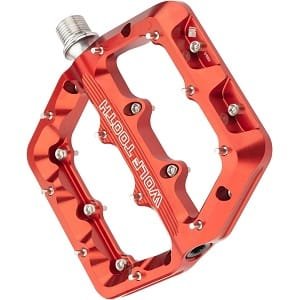
🔧 Technical Specifications
- Platform size: Small: 105 × 99 mm; Large: 112 × 106 mm—scaled to match shoe footprint
- Weight: ~373 g (Small), ~384 g (Large)
- Body material: CNC-machined 6061‑T6 aluminum; axle 17‑4 PH stainless steel; pins 304 stainless steel
- Pin count & height: 11 rear-loading pins per side, ~4.5 mm height; six extra pins included
- Profile thickness: Dual‑concave – ~12.5 mm center, ~14 mm at perimeter
- Bearing system: Three sealed cartridge bearings + one IGUS bushing with custom radial seal for weather protection
- Warranty & rebuildability: 5-year warranty; full “Right to Repair” design—every part is serviceable/replacable
The Wolf Tooth WaveForm is a high-end, American-made flat pedal crafted to combine aesthetics with performance, durability, and precision. Machined entirely in Minnesota, WaveForm pedals reflect Wolf Tooth’s commitment to local manufacture and meticulous design.
At first glance, the dual‑concave platform is a defining feature: thinner in the middle (~12.5 mm) and thicker around the perimeter (~14 mm), this shape envelops your shoe, cradling your foot both front-to-back and side-to-side for improved stability and feel. On the trail, it delivers a consistent foot position, edge grip, and a sense of foot‑shaping that many riders describe as intuitive and confidence-inspiring.
Traction comes from 11 stainless steel rear-loading pins per side (~4.5 mm tall), which grip aggressively without locking your foot completely in place. Many testers preferred WaveForm over similar pedals, noting that grip surpassed that of their OneUp Alloy or Composite favorites, even if it slightly limits repositioning mid-strike.
In real-world use—from rocky Pisgah descents to long cross-country rides—WaveForm feels both precise and durable. Its stainless spindle, sealed bearings, and radial seal resist grit and moisture effectively—riders report smooth rotation after months of wet-season trails . Moreover, bikepackers and enduro riders appreciate the “narrower Q‑factor” compared to other brands, which encourages a planted stance with less knee flare.
Another standout is the ease of serviceability. Wolf Tooth provides full replacement parts for every component—from pins to bearings to bodies—under their Right‑to‑Repair policy. End users can fully rebuild pedals at home using common hex tools—a rare feature in this class.
Although the price (~$200 USD) is higher than many alternatives, riders say the premium finish, build quality, and long-term usability justify the investment. If you’re after a pedal that looks refined, grips reliably, and can be repaired—instead of replaced—for years, WaveForm is an excellent choice.
Pros | Cons |
| 11 rear-loading steel pins per side | Relatively high price (~$200) |
| Exceptionally grippy | Bearings are custom—difficult to replace |
| replacement parts under Right-to-Repair program | Limited foot repositioning |
| Weather-sealed radial bearing system | |
| Made in USA |
6. OneUp Composite
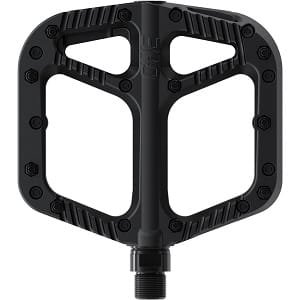
🔧 Technical Specifications
- Platform size: Large version measures ≈115 × 105 mm; small version ≈97.5 × 92 mm for smaller feet
- Weight: ~355 g for full-size; ~330 g for small version
- Body material: Nylon composite with a subtly convex profile; thin, chamfered leading edge for strikes
- Pins: 10 rear-loading steel pins per side on full-size; 7 pins per side on small; nyloc nuts secure pins
- Profile thickness: Between ~13.3 mm (leading edge) to ~18.5 mm (near axle) for full-size; small is ~18 mm at axle
- Bearings & axle: DU Plus cartridge bearing axle system with chromoly spindle; sealed for maintenance ease
- Serviceability & support: Fully serviceable; OneUp offers annual service guides and rebuild kits; durable design with proven longevity
The OneUp Composite pedal brings surprising performance at a budget-friendly price point— retailing around $50–60 USD, it’s easily the best value in quality flat pedals today. Its slightly convex platform matches the arch of your foot and lets you naturally “nestle in” for power transfer and control. Its chamfered leading edge offers trail strike forgiveness; on tighter rock garden sessions, it glides off instead of jamming into the terrain—a feature riders often highlight in real use-cases.
Although its grip is described as average in the range of convex-profile pedals, mobility stands out—riders can pivot and micro-adjust foot position more easily than on aggressively pin-heavy models. Plus, there’s no dead zones—the arrangement and reinforcements ensure grip in almost any foot landing point. Personal feedback from users weighing ~215 lbs reported good support and minimal pin wear on consistent trail use, with durable plastics standing up well even after heavy strikes and extended seasons.
Servicing is straightforward thanks to OneUp’s transparent design and tools: an annual regreasing of the spindle bearing is sufficient, and bearings often spin freely for years before replacement is needed. The pedal body hides scratches and scuffs nicely thanks to its single-color composite material, making it look newer, longer.
For riders on a budget or those trying flats for the first time—especially gravel riders, commuters, bikepackers, or regular trail users—the Composite pedal offers lightweight, large platform size, and solid reliability. Color matched with other OneUp accessories and easy to maintain, it’s often recommended as the go-to entry pedal for both casual and performance mountain biking.
Although it doesn’t have the aggressive grip of pedals like Race Face Atlas or Chromag Dagga, it balances mobility, weight, and clean design. Its proven durability, backed by thousands of miles of anecdotes, makes it a compelling choice for anyone wanting good grip and serviceability without overspending.
Pros | Cons |
| Excellent value for flat-pedal performance | Grip is average compared to concave |
| Lightweight (355 g full-size / 330 g small size) | No extra pins included in box |
| Fits most riders and supports foot arch | Slightly thicke can reduce clearance |
| Subtle convex profile | |
| OneUp’s guides and kits available | |
| Durable composite hides scratches |
7. DMR Vault
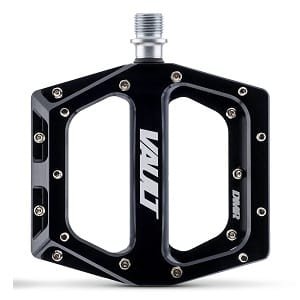
🔧 Technical Specifications
- Platform size: ~105 × 105 mm concave CNC‑machined aluminum platform; Vault Max variant expands size to ~112 × 111 mm (~11% larger)
- Weight: Standard alloy version ~430–438 g per pair; magnesium/titanium “Mag SL” as light as ~290 g; Vault Max ~450 g
- Body material: Extruded 6061‑T6 aluminum or magnesium (Mag SL variant); chamfered edges for obstacle clearance
- Axle & bearings: Heat-treated 4140 chromoly spindle; inner DU bushing + outer sealed cartridge bearing; removable with basic tools and optional service tool
- Pins: 11 replaceable flip pins per side (long ~6 mm on edges, shorter ~4 mm near axle), hex-head, reversible for grip tuning; spare pins included
- Profile thickness: Approximately ~17 mm deepest concave; ~8 mm at center; tapering edge to edge for strike protection
- Warranty & serviceability: Fully serviceable platform with DMR supply of replacement bearings, bushes, and pins; optional service tool available; rebuildable longevity
The DMR Vault has long enjoyed iconic status among flat pedals—its concave footprint and pin count deliver grip that riders talk about immediately upon placing a foot down ([turn0search9]). Despite its moderate weight (~430 g), its slim ~17 mm profile and chamfered edges help reduce strike incidents while providing a powerful platform feeling underfoot that inspires confidence across rock gardens and rooty sections.
Platform shape design, with deep concavity combined with a generous pin-to-axle distance, gives excellent stability even on rough terrain and for riders with larger feet. Many riders report a virtual “Velcro” grip feel—even without sticky soles—thanks to the union of body shape and pin distribution ([turn0search9]).
On long-term testing, pedals withstand serious mountain abuse—hammer strikes, big crashes—with minimal structural damage and no seated pin movement. User reports indicate even the Mag SL model retains its shape after extended off-road usage, though cosmetic wear is visible under heavy trail impacts. In enthusiast communities like Reddit, users note:
“The Vaults are the best pedals I’ve owned by quite a bit. They are rebuildable and to me are way more grippy and durable than… other pedals.”
Servicing is straightforward: open the end cap, remove the axle nut, re-grease or replace DU bush and bearing, flip or replace pins using standard tools. Many report needing to service the bush occasionally—but reliability remains high when maintenance is performed regularly ([turn0search11] [turn0search21]).
One downside: Outdoor Gear Lab scored the Vault as middling in grip and value compared to newer competitors like Race Face Atlas or Hope F22. Though well made, they found mobility is high (foot repositioning easy), but overall grip less intense than aggressive competitors—and the weight-to-performance ratio isn’t best-in-class today.
Still, for riders craving rebuildability, pin tuning, premium finish options, and consistent platform feel, the Vault continues to deliver—especially with the newer Vault Max option offering expanded support for larger-foot riders. Ideal for enduro, trail, or bike park riders who want long-term serviceability, grip-tunable pins, and a platform that stays dependable through years of use.
Pros | Cons |
| Deep concave platform + flippable pins | Grip slightly less intense |
| Robust CNC-machined build | Inner bushing may develop play |
| Flip-pin design for personalized grip tuning | Heavier than slimmer modern pedals |
| Fully serviceable with replacement kits | |
| Slim ~17 mm profile | |
| Wide color and finish options |
8. Chromag Dagga
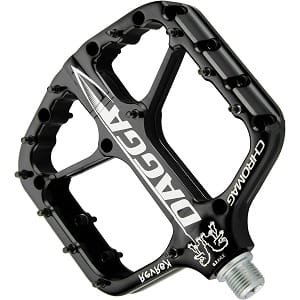
🔧 Technical Specifications
- Platform size (usable): ~115 × 110 mm (measured, excluding axle area) — among the largest in class
- Thickness (Min/Max): ~14.2 mm at center; ~16 mm at edges
- Number of pins: 12 per side; rear-loading 3 mm stainless steel pins; spacers included to adjust height (+1.5 mm)
- Body material: CNC-machined 6061‑T6 aluminum; dual concave profile; bevelled leading/trailing edges for strike protection
- Weight: ~486 g per pair — the heaviest pedal in tested group
- Serviceability & warranty: Fully serviceable with standard hex tools; spare pins included; detailed maintenance guides; durable seal design ensures longevity
The Chromag Dagga stands as the grip king of flat pedals in this lineup, designed for riders who prioritize maximal traction and a large planted platform. Developed with input from downhill legend Chris Kovarik, Dagga pedals offer a wide q‑factor—ideal for riders who find narrow pedals unstable or cramped.
Despite their large measured footprint, the Dagga feels surprisingly compact underfoot due to the smooth rounded edges—they extend further from the crank yet don’t induce more pedal strikes than smaller pedals like the Deity TMAC or Nukeproof Horizon.
The dual concave profile provides a clear channel where the shoe sinks in, creating a natural “lock-in” effect bolstered by twelve pins per side.
Traction is immediate: pins bite aggressively into the sole, and even with shoe movement, your feet stay planted unless you mean to lift them. This was consistently confirmed across multiple terrain types—from fast descents to technical climbs—where grip remained unshakable even under demanding loads.
The included spacers let you fine-tune pin height, with the option to gain another 1.5 mm for deeper bite—something many riders used to dial in comfort versus stiffness. Although pin diameter is compact (~3 mm) and sharp, the foot feels stable, not jolting—though users have noted mild shoe wear after extended use, especially on softer soles like FiveTen models.
At 486 g, Dagga is noticeably heavier than other pedals in this guide—but weight-conscious riders may be willing to accept that for added platform stability and traction.
Despite the heft, trail strikes were rare thanks to the beveled profile and platform taper. Serviceability is straightforward, and spare pins plus tools are included out of the box—maintenance resorts to simple regreasing and pin replacement as needed.
If your riding style includes downhill, enduro, bike-park laps, or you need pedals that won’t let you slip even when confidence is tested, the Dagga delivers a no-compromise solution. Before heading onto demanding trails, prepare your body for repeated climbs, descents, and technical movements with these mountain bike warm-up exercises.
Pros | Cons |
| Best-in-class grip | Heaviest pedal, not weight‑sensitive |
| Massive footprint (~115×110 mm) | May carve into soft‑sole shoes |
| Rear-loading pins with spacers | Foot mobility limited |
| 12 aggressive pins per side | |
| Weather‑sealed internals, fully serviceable | |
| Detailed support and spares included |
Complete Buying Guide: How to Choose the Best Flat Pedals for Mountain Biking
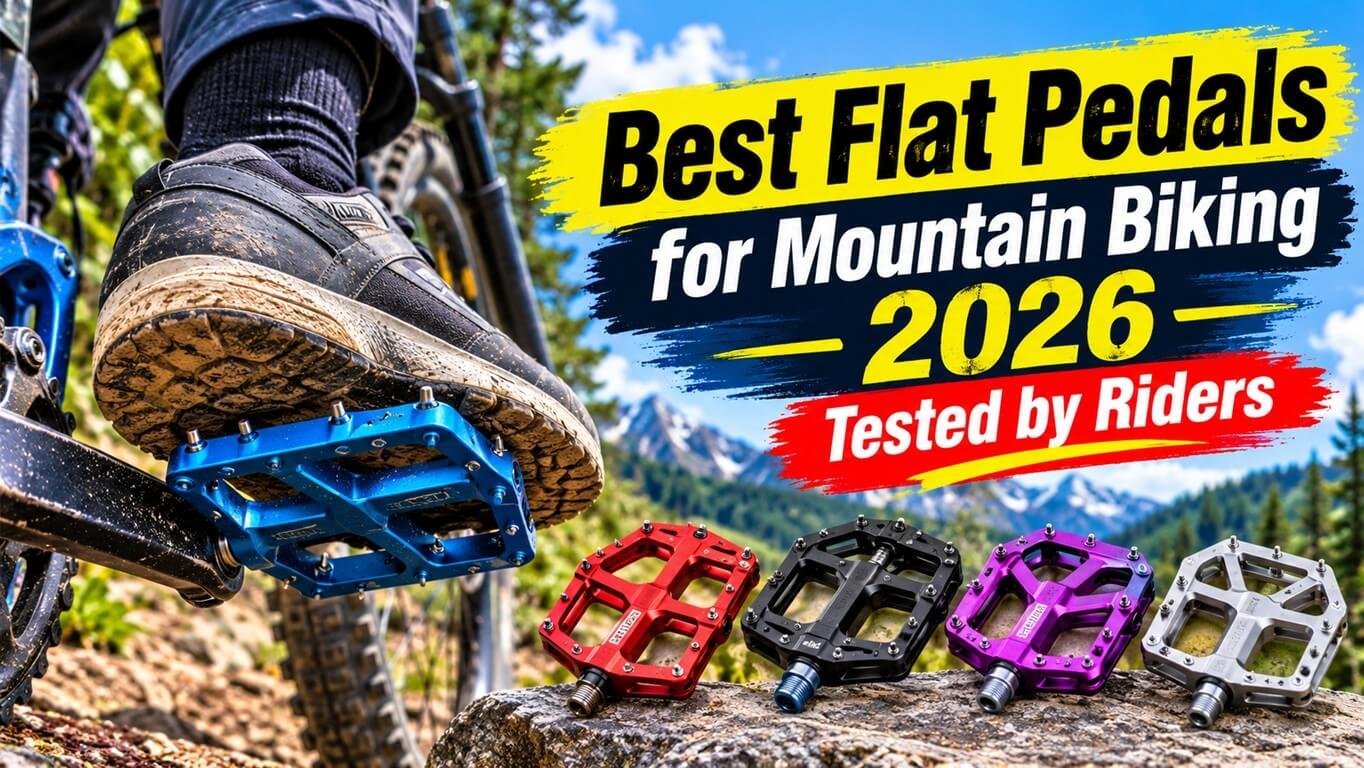
With so many high-quality options in 2026, here are the key factors to consider when picking the perfect pedals for your mountain bike setup.
1. Platform Size & Shape
The platform size impacts foot stability and power transfer. Larger pedals (~110–115 mm wide) provide more surface area, ideal for riders with bigger feet or those who prefer a planted feel. Shapes vary between flat, concave, and dual-concave designs. Concave pedals cradle your foot. This will enhance grip and reduce foot slippage. Flat platforms offer more freedom of movement.
“Pedal choice also works alongside your bike’s suspension setup. Our guide to the best mountain bike forks can help you understand other important components that affect control and comfort on technical trails.”
2. Material & Weight
- Common materials are aluminum alloy and composite nylon. Aluminum pedals offer durability and a premium feel but weigh slightly more. Composite pedals are lighter and often cheaper but might wear faster.
- Weight matters if you are conscious about bike performance; however, pedal durability and grip usually take precedence.
3. Pins and Grip
- Pins are crucial for traction. Look for pedals with replaceable, adjustable pins so you can customize grip based on shoe type and riding conditions.
- Pin number and length affect grip aggressiveness—more and longer pins mean better hold but can increase shoe wear and reduce mobility.
4. Profile Thickness & Clearance
Pedal thickness influences clearance over rocks and roots. A thinner pedal reduces the chance of strikes, but extremely thin pedals might compromise comfort or grip. Chamfered or beveled edges help the pedal shed obstacles and reduce harsh impacts.
5. Bearings & Maintenance
High-quality sealed cartridge bearings and bushings ensure smooth rotation and durability in wet or muddy conditions. Consider how serviceable the pedals are—are parts replaceable? Can you rebuild the pedal yourself? This affects long-term value and reliability.
6. Shoe Compatibility
Pairing pedals with proper flat-soled shoes maximizes grip and control. Softer soles like FiveTen may wear faster on aggressive pins, while harder soles offer durability but may reduce micro-mobility on the pedal.
7. Riding Style & Terrain
Aggressive riders or downhill enthusiasts benefit from larger platforms with aggressive pins (e.g., Chromag Dagga, DMR Vault).
- Trail and enduro riders often prefer balanced pedals with good grip and serviceability (e.g., Hope F22, Race Face Atlas).
- Beginners or budget riders might opt for value-focused pedals like OneUp Composite.
8. Price & Warranty
- Pedals range from $50 entry-level models to $200+ premium options.
- Check for manufacturer warranties and crash coverage for peace of mind, especially if you ride aggressively or bike park frequently.
FAQs About Best Flat Pedals for Mountain Biking
Are flat pedals better than clipless for mountain biking?
Flat pedals offer more freedom to put a foot down and slide quickly, which is great for technical terrain and beginners. Clipless pedals provide a more efficient power transfer but require specific shoes and technique. The best choice depends on your riding style and comfort level.
How often should I replace pins on my flat pedals?
Pin wear depends on terrain and riding style. Aggressive riders or those hitting rocky trails need to replace pins every few months. Most pedals come with spare pins, and regular inspection for wear or bending is advised to maintain grip.
Can I use any flat pedal with any flat-soled shoe?
Technically yes, some shoes pair better with specific pedals. Harder soles provide durability but less grip; softer soles offer better bite but wear faster. Some pedals have pins that might be too aggressive for delicate soles, so matching shoe and pedal for your preferred feel is ideal.
How do I maintain my flat pedals to ensure longevity?
Regularly clean off mud and debris, check and tighten pins, and service bearings as recommended by the manufacturer. Many pedals allow bearing replacement or regreasing. Keeping pedals clean and well-maintained ensures smooth rotation and extended lifespan.
Why do some pedals have asymmetric or concave platforms?
Asymmetric and concave platforms contour to your foot shape, improving grip and stability. This design helps “lock” your foot in place naturally without sacrificing the freedom to reposition slightly during riding.
Are heavier pedals bad for mountain biking performance?
Although lighter pedals reduce rotational weight, slightly heavier pedals often offer more durability and grip features. Most riders won’t notice minor weight differences unless racing at elite levels. Durability and grip often trump weight in trail riding.
✅ Final Thoughts
In our full lineup of flat pedals available in 2026, the Chromag Dagga is the grippiest, most planted platform of them all—built for riders who demand maximum traction, platform support, and rugged real‑world durability. Although its weight and wide stance may not suit everyone, for aggressive trail, enduro, or big mountain riding, it’s an interesting choice when grip is the No. 1 priority.
The complete set of eight pedals we’ve reviewed balances a range of priorities:
- Crank‑brothers Stamp 3: lightweight, elegant, size‑tailored, low‑profile all‑rounder.
- Deity T‑Mac: concave, robust, high‑support platform with excellent durability.
- Hope F22: precision CNC‑machined feel with customizable grip and minimal weight.
- Race Face Atlas: bold platform with slim profile and lifetime warranty.
- Wolf Tooth WaveForm: beautifully machined, dual‑concave confidence with repairable design.
- OneUp Composite: best entry/value pick—large, light, and forgiving.
- DMR Vault: deep concave grip with rebuildable design and long-term reliability.
- Chromag Dagga: supreme grip and size with premium finish and serviceability.