
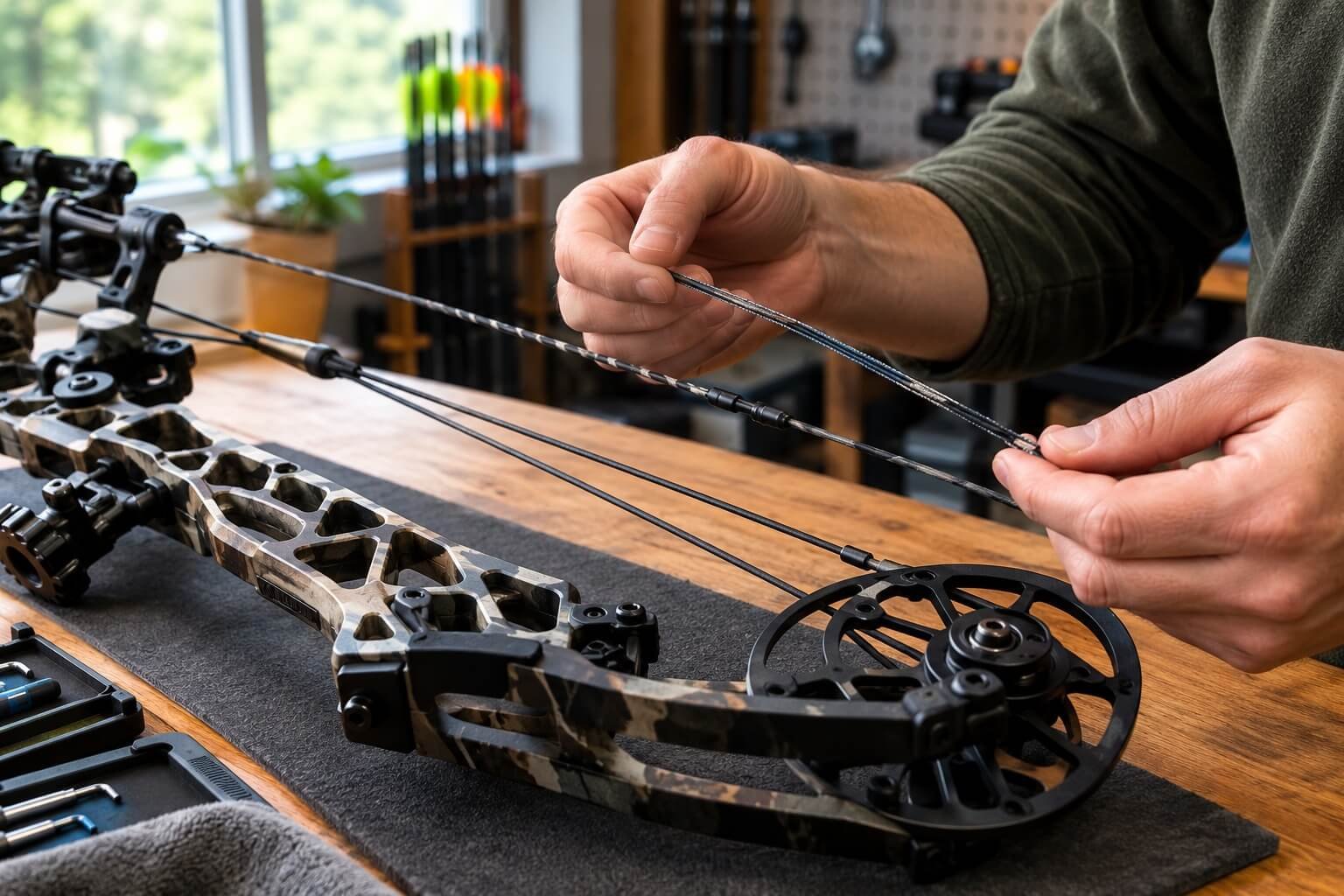
Bowstring Wax Alternatives: What Can You Use Safely?

If you have run out of bowstring wax, the safest choice is to use a replacement product specifically formulated for bowstrings and approved for your bowstring material. A substitute is not automatically safe simply because it contains wax.
Some traditional archers use pure beeswax on compatible traditional bowstrings, and World Archery identifies natural beeswax as an option for traditional archers. However, that does not mean every beeswax product is appropriate for every modern compound bow, recurve bow, or crossbow string.
Avoid experimenting with petroleum jelly, household oils, furniture polish, random lubricants, or candle wax of unknown composition. Their ingredients and physical properties may not suit your string. If you cannot confirm that a substitute is compatible with your equipment, wait until you can obtain suitable bowstring wax rather than risk damaging an essential component of your bow.
Why Does a Bowstring Need Wax?
A bowstring is made from multiple strands of fiber that must work together under repeated tension. Over time, shooting, friction, moisture, dirt, and normal wear can affect the condition of those fibers. Bowstring wax helps maintain the string by:
- Reducing friction between strands: Appropriate wax helps protect the fibers as they move against one another.
- Limiting moisture penetration: Wax provides a degree of protection against moisture reaching the fibers.
- Helping strands remain bundled: A suitable wax helps maintain the condition of the string bundle.
- Supporting routine maintenance: Regular inspection and appropriate waxing can help identify developing wear before it becomes more serious.
World Archery’s guide to bowstring maintenance explains the importance of waxing, working the product into the strands, and inspecting the string for wear. Wax is not a repair material, however. It cannot restore broken fibers, repair damaged serving, or make a worn-out string safe again.
1. Beeswax: Is It a Safe Bowstring Wax Alternative?
Beeswax is one of the most commonly discussed natural alternatives to commercial bowstring wax. Whether it is appropriate depends on the bowstring, the wax formulation, and the manufacturer’s maintenance instructions.
When might beeswax be appropriate?
Traditional archers use suitable beeswax on compatible traditional bowstrings. World Archery specifically mentions natural beeswax as an option for traditional archers. However, there is an important distinction between pure beeswax and a commercial product containing beeswax as one ingredient.
A commercial archery wax combines several ingredients to achieve particular application, flexibility, and protective properties. A household beeswax product may contain additives, fragrances, oils, or other ingredients that have not been evaluated for your string.
Can you use pure beeswax on a modern compound bow?
Do not assume that you can. Modern compound bowstrings and cables may use specialized synthetic fibers, and the manufacturer may specify particular maintenance products.
Before using beeswax, check the bowstring manufacturer’s guidance and the bow manufacturer’s maintenance instructions. If they do not explicitly support your proposed product, choose a dedicated bowstring wax instead.
Verdict: Beeswax may be an option for some compatible traditional setups, but it is not a universal substitute for modern bowstring wax.
2. Candle Wax: Can You Use It on a Bowstring?
Candle wax might seem like a convenient alternative because it is inexpensive and readily available. Nevertheless, ordinary candle wax should not be treated as an interchangeable bowstring maintenance product.
Candles can be made from different waxes and blends, including paraffin and other materials. Some also contain dyes, fragrances, or additives. Their formulations and performance characteristics are not necessarily designed for archery strings. The fact that candle wax is solid at room temperature does not establish that it will work appropriately with your string.
What is the safer choice?
Use a product explicitly intended for bowstring maintenance and compatible with your equipment. If you have only candle wax available, do not experiment on your shooting bow. This is particularly important if you use a compound bow for hunting. Your string and cables are critical components, and an improvised maintenance product is an unnecessary uncertainty.
Verdict: Ordinary candle wax is not a recommended general-purpose substitute. Use dedicated bowstring wax unless your equipment manufacturer explicitly approves a particular alternative.
3. Petroleum Jelly and Vaseline: Are They Suitable?
Petroleum jelly, including products sold as Vaseline, is sometimes suggested as a household substitute for wax. It should not be treated as an approved bowstring maintenance product.
Petroleum jelly is formulated for different purposes than bowstring wax. Its consistency, residue, and interaction with the materials in your particular string may differ from those of a purpose-made archery product. Applying it without manufacturer approval introduces uncertainty rather than solving the maintenance problem.
What if you have already applied petroleum jelly?
Do not panic or immediately assume that your string is ruined. The appropriate response depends on the product, the amount applied, and the string’s condition.
- Stop adding the substitute.
- Check the bow and string manufacturer’s care instructions.
- Contact the bowstring manufacturer or a qualified archery technician for product-specific cleaning advice.
- Have the string inspected if you notice unusual residue, fraying, separation, or other damage.
Avoid using solvents or aggressive cleaning methods to remove residue unless the manufacturer specifically recommends them. Some cleaning products may create additional compatibility problems. Do not use petroleum jelly as a routine replacement for bowstring wax.
4. Lip Balm: Can It Replace Bowstring Wax?
Lip balm may contain waxes, oils, petroleum-derived ingredients, fragrances, and other additives. Its formulation is intended for personal care, not for maintaining a high-tension archery string.
Even a balm that feels waxy or appears to coat the fibers smoothly has not necessarily been formulated or tested for bowstring maintenance. There is also no reliable way to judge compatibility simply by looking at the ingredient list or feeling the product between your fingers.
Avoid lip balm as a bowstring wax substitute. Choose a product designed for your bowstring instead.
5. Furniture Wax, Shoe Wax, and General-Purpose Waxes
Household and automotive products may contain waxes, oils, solvents, silicones, dyes, or other additives. Their intended uses and formulations differ from those of archery maintenance products. A product that protects wood, leather, shoes, or vehicle paint is not automatically appropriate for synthetic bowstring fibers.
The same principle applies to general-purpose lubricants and sprays: a product being useful on one piece of equipment does not make it suitable for every component of a bow. Before using any alternative, confirm all of the following:
- The product is intended for bowstring maintenance or explicitly approved by the equipment manufacturer.
- It is compatible with your string material and bow type.
- Its application instructions match the areas of the string that require maintenance.
- It will not conflict with the manufacturer’s guidance for serving, cables, or other components.
If these points cannot be confirmed, do not use the product as a substitute.
Verdict: Do not substitute furniture wax, shoe wax, car wax, or general-purpose lubricants for dedicated bowstring wax without explicit manufacturer approval.
Bowstring Wax Alternatives Compared
The following table summarizes how to approach the most commonly suggested substitutes. It is a compatibility guide, not a claim that every formulation has been laboratory-tested on every string material.
| Product or alternative | Recommended approach | Main concern |
|---|---|---|
| Dedicated bowstring wax | Preferred option | Confirm compatibility with your equipment |
| Manufacturer-approved alternative wax | Use according to its instructions | Approval may be specific to certain strings |
| Pure beeswax | Consider only for compatible setups where guidance supports it | Not universally suitable for modern strings |
| Ordinary candle wax | Avoid as an improvised substitute | Formulation and additives vary |
| Petroleum jelly or Vaseline | Avoid | Not formulated specifically for bowstring care |
| Lip balm | Avoid | May contain unsuitable oils and additives |
| Furniture or car wax | Avoid unless explicitly approved | Intended for different materials and uses |
| General-purpose oil or lubricant | Do not use as bowstring wax | Not interchangeable with bowstring wax |
The practical takeaway is simple: the safest alternative is usually another compatible archery-specific wax, not a household product.
What Should You Do If You Run Out of Bowstring Wax?
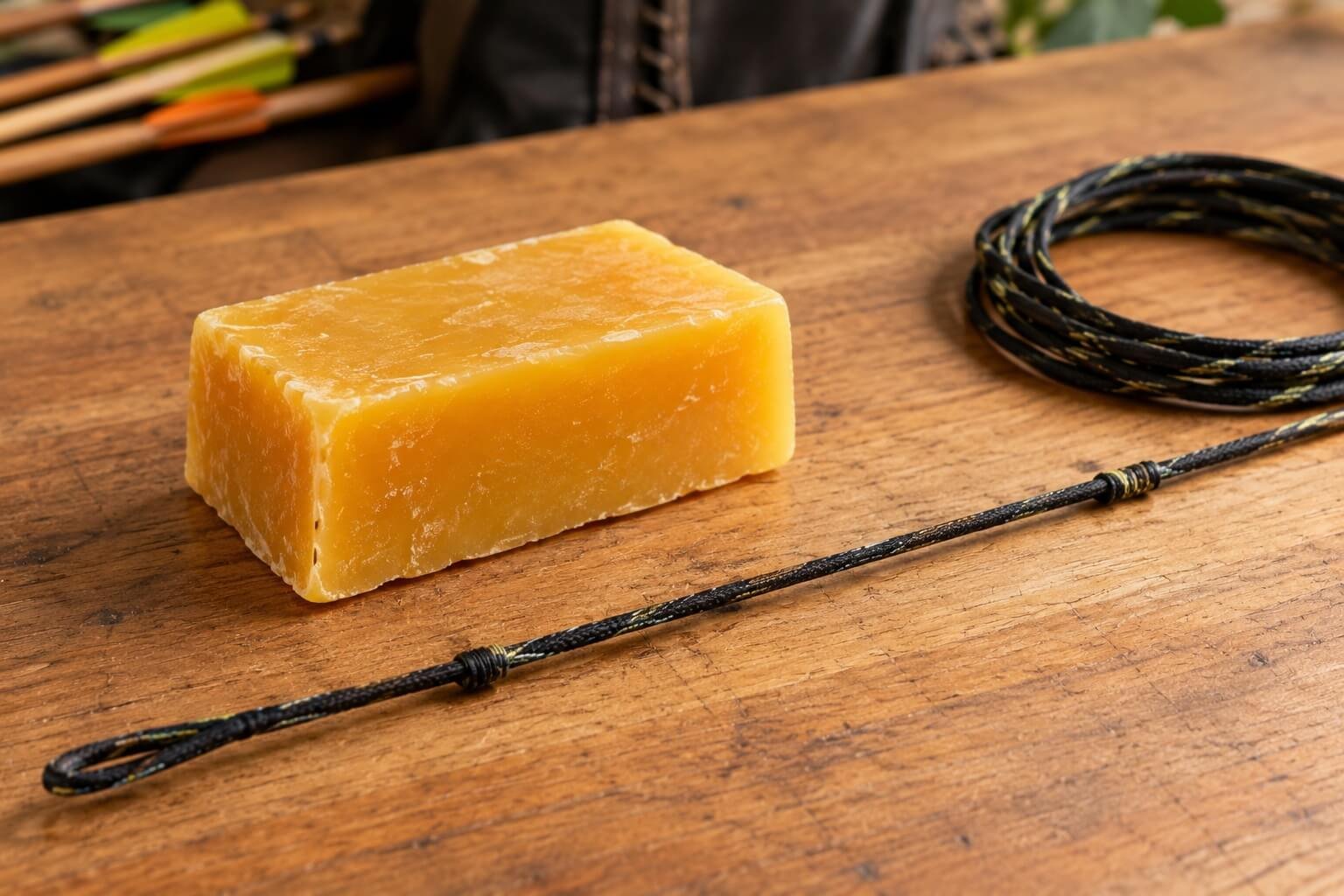
Running out of wax does not automatically mean your bowstring is unsafe. What matters is its condition, the type of bow you use, and whether maintenance is due. Follow this decision process before your next shooting session.
Step 1: Inspect the string
In good lighting, examine the exposed string fibers along their working length. Look for:
- Fuzzy or frayed fibers
- Broken or separated strands
- Unusual discoloration
- Areas that appear abraded or damaged
- Serving that has shifted, loosened, or separated
A slightly dry-looking string is not the same as a string with broken fibers. However, visual inspection cannot rule out every form of damage.
Step 2: Check the maintenance instructions
Look at your bow’s manual and the instructions provided by the string manufacturer. Confirm which wax is recommended and whether any alternative is permitted. If you use a compound bow, pay attention to the cables as well as the main bowstring. Different sections may have different maintenance requirements.
Step 3: Decide whether the bow needs attention
If the string is in good condition and maintenance is not yet due, you may be able to wait until you obtain the correct product. If the string is visibly damaged, do not try to make it usable by applying wax. Have it assessed by a qualified technician and replace it when necessary. If your string needs replacing, read our guide to the best bow strings to compare options for different bow types and shooting needs.
Step 4: Use the correct product when available
Apply the approved wax according to the manufacturer’s instructions. Use the correct amount and avoid areas that the manufacturer says should not be waxed. Do not fire a bow with a string or cable you suspect is damaged simply because it has been cleaned or coated with a substitute.
How to Maintain a Bowstring Without Using a Substitute
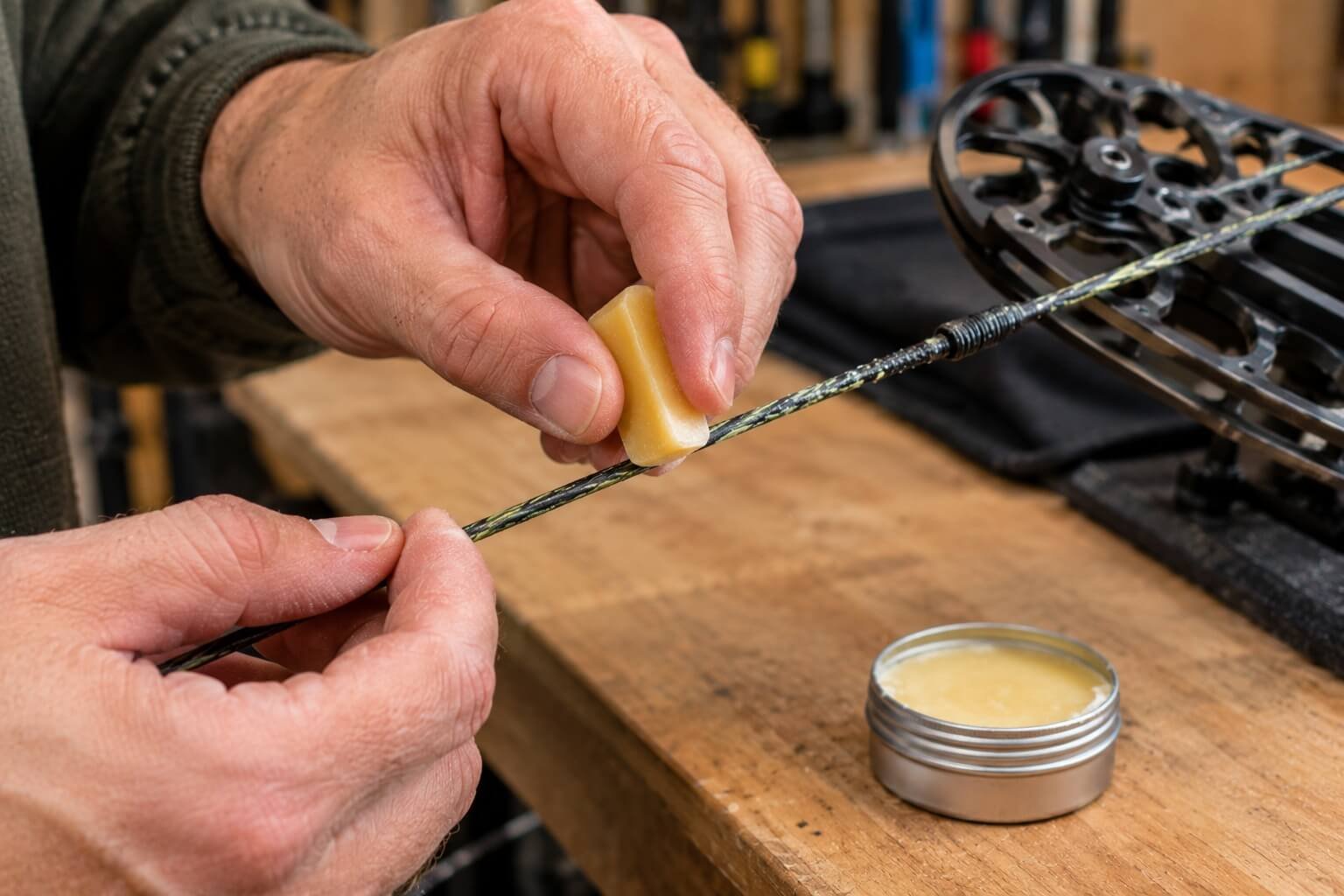
If your goal is to extend string life or avoid unnecessary spending, proper maintenance is more useful than experimenting with household products.
1. Inspect the string regularly
Make string inspection part of your normal pre-shooting routine. Check the exposed fibers, serving, loops, and—on compound bows—the cables and their contact areas. Look for changes from the string’s usual condition. If you identify damage, stop and seek an appropriate assessment rather than trying to cover it with wax.
2. Apply compatible bowstring wax correctly
Follow the directions supplied with your wax and bowstring. In general, waxing involves applying a suitable amount to the areas intended for treatment and working it into the strands as instructed. Avoid excessive application. A thick, sticky layer is not necessarily better protection, and excess residue can collect dirt.
3. Keep the serving areas in mind
Serving is the tightly wrapped thread found in important areas such as the center of the string and the loops. It may require different care from the exposed string fibers.
World Archery’s maintenance guide advises archers not to wax the serving in the usual way because wax can make it slippery. Some equipment has specific requirements, so follow the manufacturer’s directions rather than applying wax indiscriminately.
4. Keep the bow dry and store it appropriately
After shooting in wet conditions, follow your bow manufacturer’s instructions for drying and storage. Avoid leaving equipment in persistently damp environments or exposing it to unnecessary heat. Do not use a household lubricant to compensate for poor storage conditions.
If you’re also looking to reduce bowstring noise and vibration, explore our guide to the best bow string silencers and learn about another way to fine-tune your archery setup.
5. Know when waxing is no longer enough
Wax helps with maintenance; it does not reverse structural damage. If you find broken strands, significant fraying, separated fibers, or concerning damage around the serving or cables, stop using the bow until it has been assessed. A damaged string or cable may need replacement.
The Archery Trade Association’s equipment-care workshop guidance also distinguishes routine maintenance from more advanced work that should be left to qualified professionals.
How Often Should You Wax a Bowstring?
There is no single schedule that applies to every bowstring. The correct interval depends on the bowstring material, the manufacturer’s instructions, how frequently you shoot, and your shooting and storage conditions.
For example, Bohning’s 2026 product catalog recommends waxing every 200 shots for its bowstring-care guidance. Treat that as a manufacturer-specific recommendation, not a universal rule for every bow and string.
A practical routine is to:
- Check the string regularly.
- Follow the recommended waxing interval for your equipment and wax.
- Inspect the string after exposure to wet or unusually dirty conditions.
- Avoid applying more wax simply because you believe frequent application must be better.
- Seek professional advice if the string’s condition is uncertain.
If you are unsure when your string was last waxed, inspect it and consult the manufacturer’s recommendations rather than relying on a generic schedule.
FAQs About Bowstring Wax Alternatives
Can I use beeswax instead of bowstring wax?
Possibly, if your particular bowstring is compatible with the beeswax product and the manufacturer permits it. World Archery identifies natural beeswax as an option for traditional archers. That does not establish that every beeswax product is suitable for modern compound bowstrings or crossbow strings.
Can I use candle wax on a compound bowstring?
Do not use ordinary candle wax as an improvised substitute. Candle formulations vary, and household candles are not necessarily formulated for archery-string maintenance. Use compatible bowstring wax instead.
Can I use Vaseline on my bowstring?
Vaseline is not a recommended replacement for dedicated bowstring wax. If you have already applied it, stop adding the product and ask the string manufacturer or a qualified archery technician how to proceed.
Can I use lip balm to wax my bowstring?
Avoid it. Lip balm may contain ingredients that have not been evaluated for your bowstring. A waxy texture alone does not demonstrate compatibility.
Can I use silicone spray instead of bowstring wax?
Do not assume that silicone spray is suitable. A spray lubricant is not necessarily equivalent to a wax formulated for bowstring maintenance. Use only products approved for your specific equipment and application.
What happens if I shoot without waxing my bowstring?
The consequences depend on the string’s condition, the material, and the manufacturer’s maintenance requirements. Neglected maintenance can contribute to increased wear and moisture-related problems. However, a string does not automatically become unsafe simply because it has not been waxed on a particular day.
Inspect it, follow the recommended maintenance schedule, and do not shoot if you find damage or suspect that the string or cables are compromised.
Should I wax the center serving?
Not unless your equipment manufacturer’s instructions call for it. Serving has a different function from the exposed string fibers, and wax can make some served areas slippery. Follow the guidance for your particular bow.
Does bowstring wax repair frayed fibers?
No. Wax is a maintenance product, not a structural repair. Broken or significantly damaged fibers require assessment and may require string replacement.
Is bowstring wax different from crossbow string wax?
Products can differ according to their intended application. Some may be suitable for multiple types of strings, while others have specific uses. Check the product label and your crossbow manufacturer’s instructions before using a wax intended for a different setup.
What is the best thing to use if I have no bowstring wax?
If you cannot verify that an alternative is compatible with your string, wait until you can obtain a suitable archery-specific product. If the string is damaged or its condition is uncertain, have it inspected before shooting.
Final Verdict: Which Bowstring Wax Alternative Is Best?
For most archers, the best approach is to replace the missing wax with a product designed for bowstring maintenance rather than experiment with household substitutes.
Pure beeswax may be appropriate for some compatible traditional bowstrings, but it should not be treated as a universal alternative. Ordinary candle wax, petroleum jelly, lip balm, furniture wax, and general-purpose lubricants are not reliable substitutes without explicit manufacturer approval.
More importantly, no wax can repair a damaged string. Inspect your equipment regularly, use products compatible with your setup, and consult a qualified archery technician when you find broken strands or other concerning wear.
Need help choosing the right product? Read our guide to the best bowstring wax options to compare dedicated products and choose one suited to your bow.
Editorial and safety note: This article provides general equipment-care information, not a guarantee that any substitute is safe for every bowstring. Recommendations can differ by manufacturer, string material, and bow type. Always consult the instructions for your specific equipment before using an alternative product.