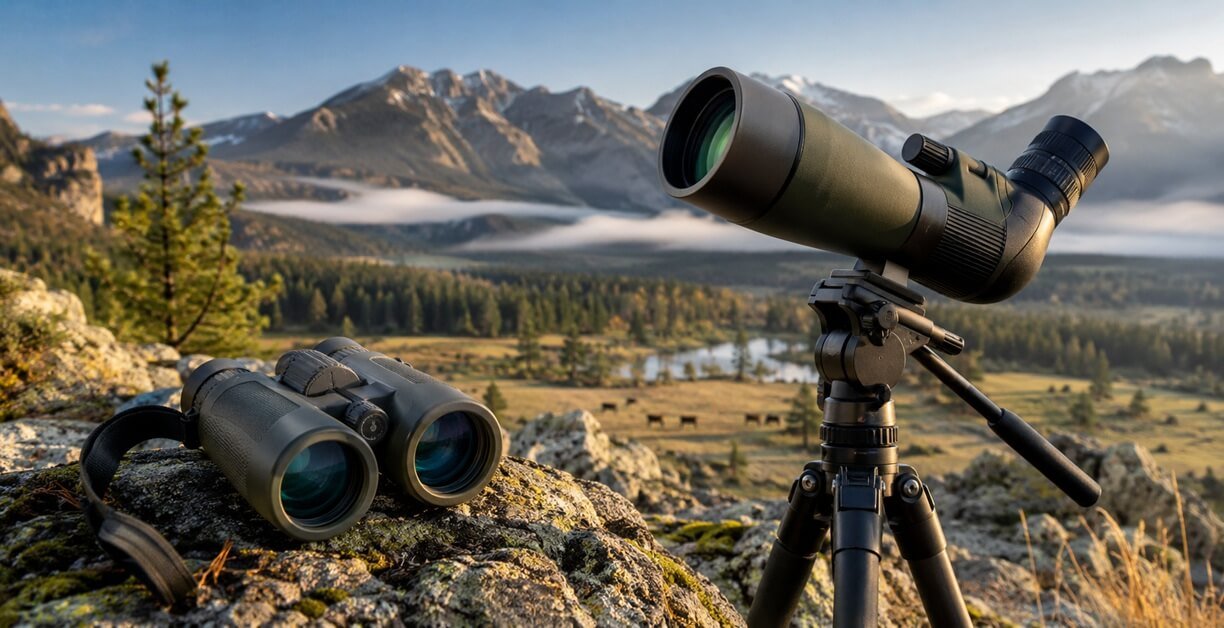
Binocular and Spotting Scope: The Complete Guide 2027

Choosing outdoor optics can quickly become confusing. Binoculars come in configurations such as 8×32, 8×42, 10×42, and 10×50, while spotting scopes may be labeled 15–45×60, 20–60×80, or 20–60×85. Then there are terms such as ED glass, phase correction, dielectric coatings, eye relief, field of view, exit pupil, and close-focus distance.
The good news is that you don’t need to become an optical engineer to choose the right pair of binoculars or a spotting scope. You simply need to understand what the important specifications mean, how they affect real-world viewing, and which features matter for the activity you actually plan to do.
This complete binocular and spotting scope guide explains the differences between the two, breaks down the most important specifications, compares popular configurations, and shows how to choose the right optic for hunting, hiking, birdwatching, wildlife observation, shooting, travel, and astronomy.
Quick Answer: Binoculars vs. Spotting Scopes
- Binoculars are generally the better choice when portability, a wide field of view, and quick target acquisition are important.
- Spotting scopes are better when you need substantially more magnification and detail at long distances and are willing to use a tripod.
| Feature | Binoculars | Spotting Scope |
| Portability | Excellent | Moderate to poor |
| Typical magnification | 6×–12× | Approximately 15×–60×+ |
| Field of view | Generally wider | Generally narrower |
| Handheld use | Excellent at moderate magnification | Not practical at high magnification |
| Tripod | Optional for many models | Usually essential |
| Long-distance detail | Good | Excellent |
| Finding moving subjects | Easier | More difficult at high power |
| Hunting | Excellent | Excellent for long-range glassing |
| Hiking | Excellent | Usually too bulky |
| Birdwatching | Excellent | Excellent for distant subjects |
| Shooting range | Limited | Excellent |
| Digiscoping | Possible | Excellent |
| Sharing between users | Easy | Easier with angled scopes |
The best setup for many serious outdoor users isn’t choosing one over the other. Binoculars and a spotting scope can complement each other extremely well.
What Are Binoculars?
Binoculars are two optical systems combined into one instrument so you can view a distant subject with both eyes. The basic optical path includes objective lenses, prisms, focusing components, and eyepieces. The objective lenses collect light, and the optical system magnifies the scene before delivering the image to your eyes.
One of the biggest advantages of binoculars is their ability to provide a natural, immersive view while remaining relatively compact. Because you use both eyes, binoculars are particularly useful for scanning large areas, following moving animals, identifying birds, and observing landscapes. They are also much easier to carry than a spotting scope and tripod.
When Are Binoculars the Better Choice?
Choose binoculars when you:
- Hike or backpack frequently
- Need lightweight optics
- Follow moving wildlife
- Scan large areas
- Hunt in thick or mixed terrain
- Watch birds at relatively close and moderate distances
- Travel frequently
- Want an optic you can use without a tripod
- Need to quickly acquire a subject
For general outdoor use, configurations around 8×42 and 10×42 are particularly versatile.
What Is a Spotting Scope?
A spotting scope is essentially a compact terrestrial telescope designed for observing distant subjects. Compared to binoculars, spotting scopes generally provide much higher magnification and are normally mounted on a tripod for stability.
A configuration such as 20–60×80 indicates a zoom magnification range of 20× to 60× and an 80 mm objective lens. Spotting scopes are especially useful when you need to examine details that are simply too small or distant for conventional binoculars.
For example, a hunter may use binoculars to locate an animal and then switch to a spotting scope to inspect the animal at greater distance. Birdwatchers can use the same approach when a bird is too far away for binocular identification.
Binoculars vs. Spotting Scopes: What’s the Difference?
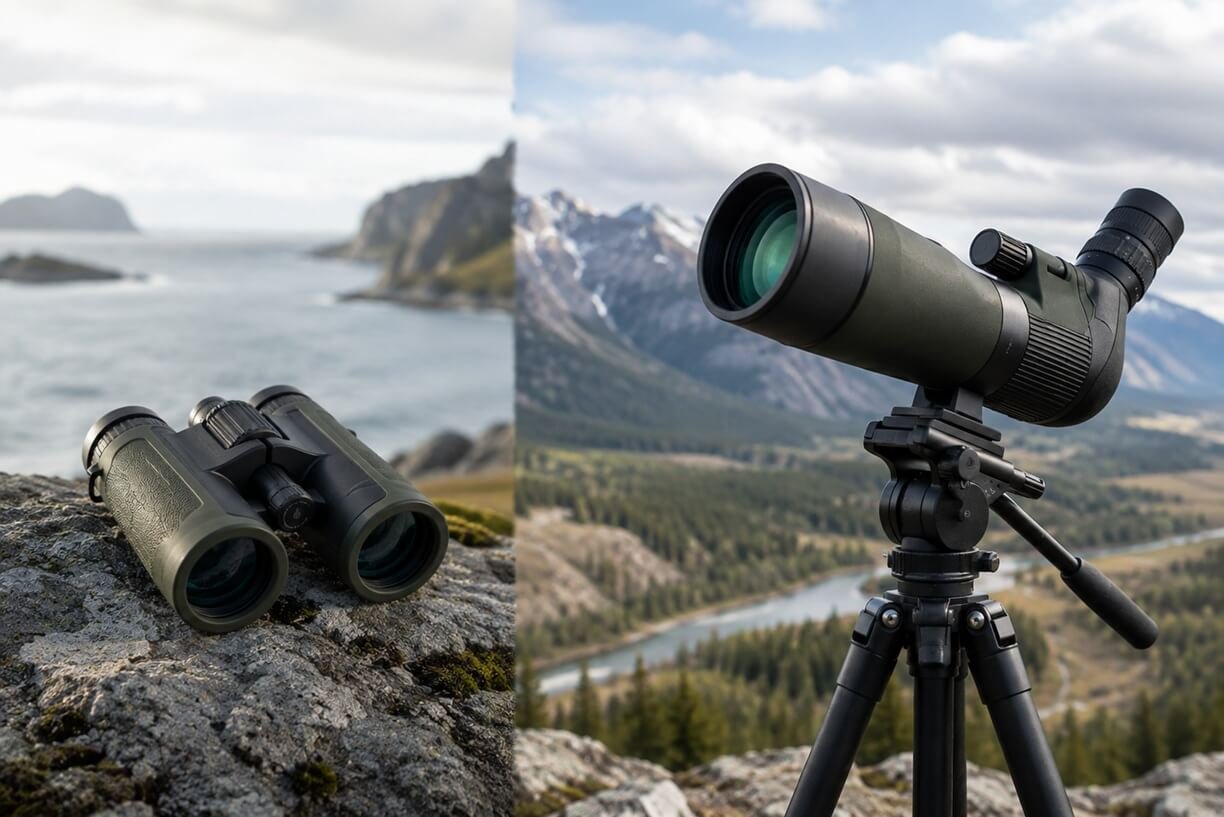
The fundamental difference is magnification and intended use. Binoculars prioritize portability, field of view, and comfortable handheld observation. Spotting scopes prioritize long-range magnification and detailed observation.
Higher magnification isn’t automatically better. As magnification increases, hand movement becomes more noticeable, and the field of view generally becomes narrower. Nikon similarly notes that increasing binocular magnification can reduce stability, field of view, and apparent brightness.
This is why a good 8×42 binocular can be much more useful for scanning a forest than a very high-powered optic. A spotting scope, meanwhile, makes sense when your subject is far enough away that you need considerably more magnification and can accept the extra weight and tripod.
Understanding Binocular Numbers
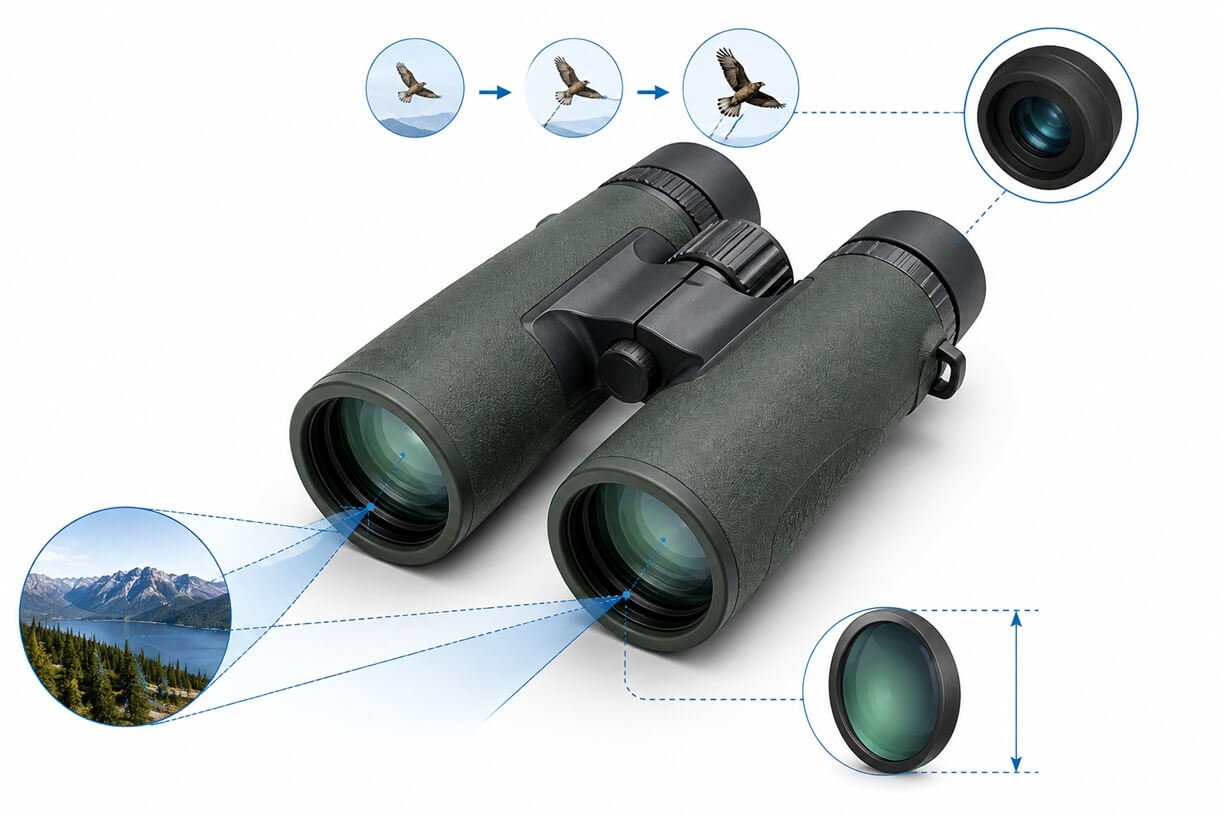
The numbers printed on binoculars tell you two of the most important specifications.
For example:
8×42
The first number, 8×, represents magnification. The second number, 42, represents the objective lens diameter in millimeters.
Therefore:
- 8×32 = 8× magnification with 32 mm objectives
- 8×42 = 8× magnification with 42 mm objectives
- 10×42 = 10× magnification with 42 mm objectives
- 10×50 = 10× magnification with 50 mm objectives
- 12×50 = 12× magnification with 50 mm objectives
The larger objective generally allows more light to enter the optical system, although larger objectives also increase weight and physical size.
Understanding Spotting Scope Numbers
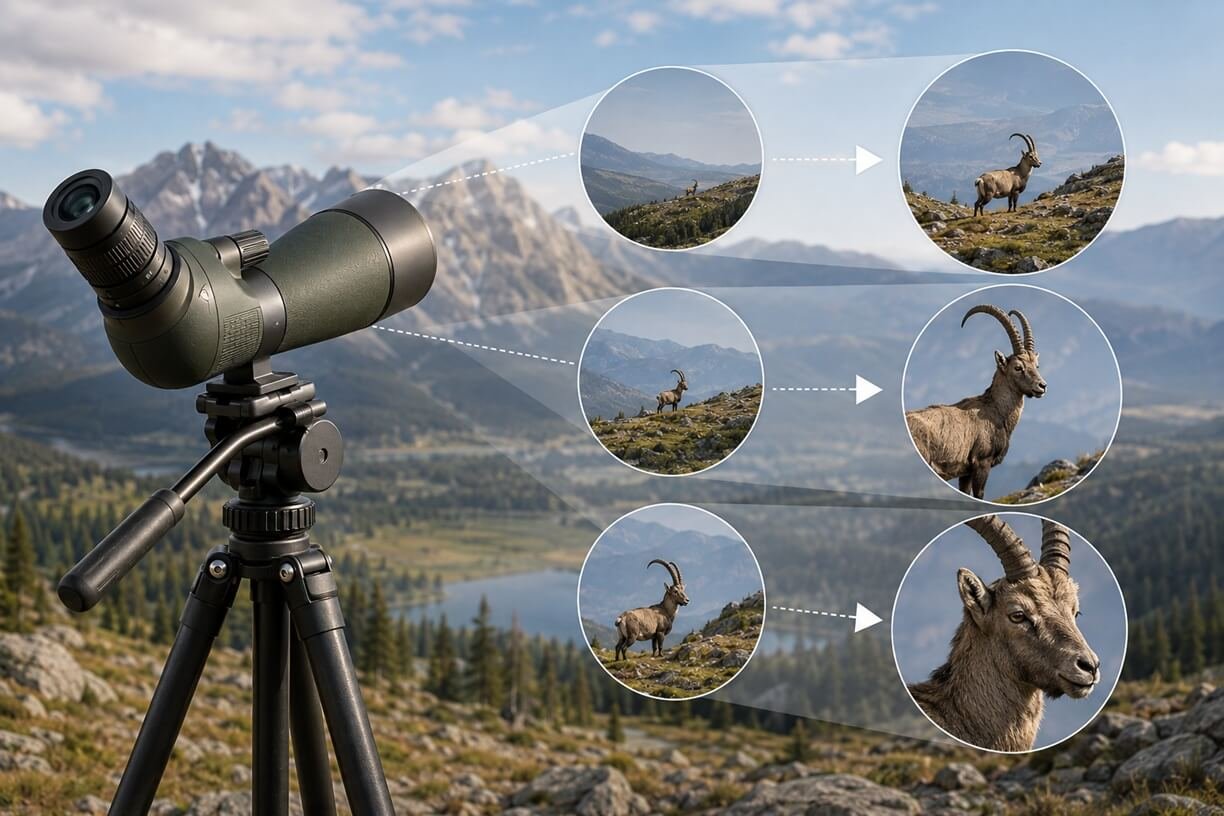
Spotting scopes use a similar naming system.
For example:
20–60×80
This means:
- Minimum magnification: 20×
- Maximum magnification: 60×
- Objective lens diameter: 80 mm
Another example:
15–45×60
means:
- 15× minimum magnification
- 45× maximum magnification
- 60 mm objective lens
The first number is particularly useful when scanning because lower magnification normally gives you a wider field of view. The higher end is useful when you need additional detail. This is why zoom scopes are practical: you can locate the subject at lower power and then increase magnification once you have it centered.
How Much Binocular Magnification Do You Need?
More magnification sounds attractive, but there is a trade-off.
6×–7×
These are easy to hold steady and provide a wide field of view.
They can be useful for:
- General observation
- Boating
- Close wildlife
- Wide-area scanning
8×
An 8× binocular is one of the most versatile choices for outdoor activities.
It provides a useful balance between:
- Magnification
- Stability
- Field of view
- Brightness
- Portability
An 8×42 is particularly versatile for hiking, hunting, wildlife observation, and birdwatching.
10×
10× provides additional reach without moving into the extreme magnification range. A 10×42 is an excellent choice when you want more detail than 8× binoculars provide while keeping the package reasonably portable. The downside is that 10× binoculars can be more sensitive to hand movement.
12× and higher
Higher-powered binoculars can provide excellent detail, but they are increasingly difficult to hold steady. A tripod or other support becomes much more useful.
For general handheld use, higher magnification is not necessarily an upgrade. Nikon recommends magnifications up to around 12× for comfortable general use and points out the stability and field-of-view disadvantages of higher magnification.
8×42 vs. 10×42 Binoculars
This is one of the most common decisions outdoor users face.
| Feature | 8×42 | 10×42 |
| Magnification | 8× | 10× |
| Objective | 42 mm | 42 mm |
| Stability | Better | More sensitive to movement |
| Field of view | Generally wider | Generally narrower |
| Detail at distance | Very good | Better |
| Scanning | Excellent | Good |
| Moving wildlife | Excellent | Good |
| Long-distance observation | Good | Excellent |
| General outdoor use | Excellent | Excellent |
- Choose 8×42: If you prioritize comfort, scanning, moving subjects, and a wide field of view.
- Choose 10×42: If you frequently observe distant wildlife and want additional magnification while keeping the binoculars relatively compact.
Neither configuration is universally better.
Objective Lens Size Explained
The objective lenses are the large lenses at the front of the binoculars or spotting scope. Their diameter affects light gathering, physical size, and weight. Common binocular objective sizes include:
- 20–25 mm: compact
- 30–32 mm: lightweight
- 40–42 mm: general-purpose
- 50–56 mm: larger, often better suited to low-light use
Spotting scopes commonly use much larger objectives, often around 50–100 mm depending on the design and intended use. Larger objectives can provide brighter images but increase weight and bulk.
Larger Isn’t Always Better
A 56 mm binocular collects more light than a 32 mm model, but you’ll also have to carry the extra weight. For backpacking or hiking, the lighter optic may be the better overall choice. For stationary dawn or dusk observation, a larger objective can make more sense. The right size depends on how you use the optic.
Understanding Exit Pupil
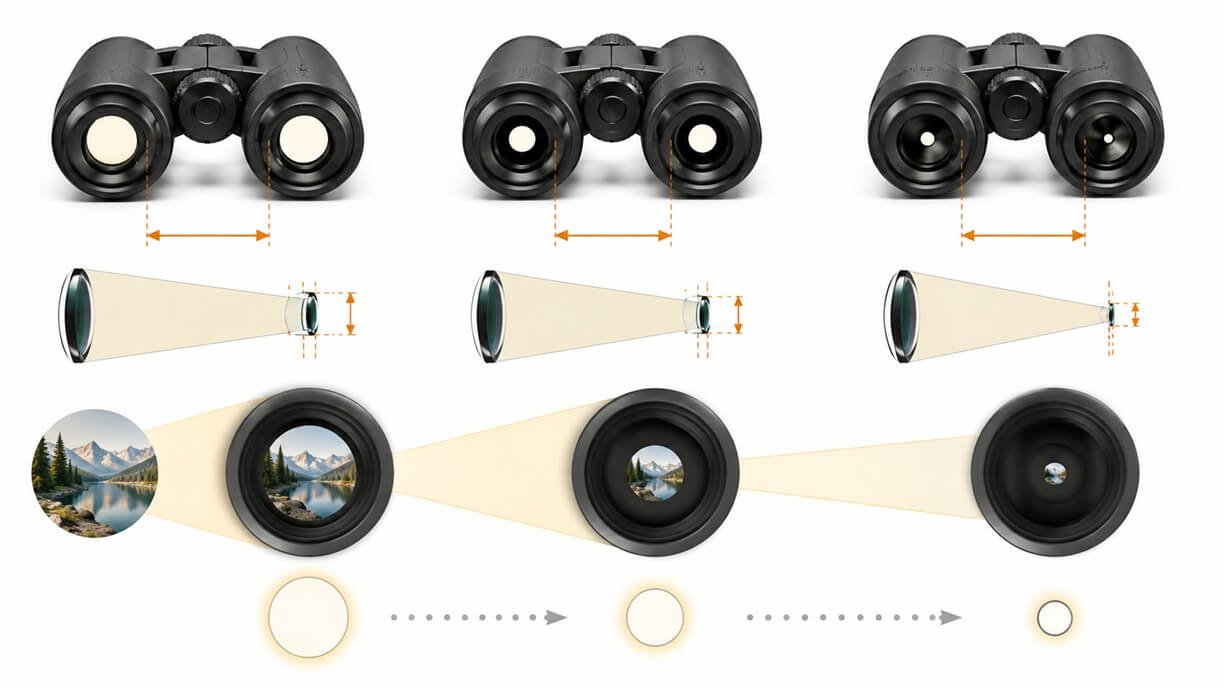
Exit pupil is one of the most useful specifications for understanding the relationship between magnification and objective size.
The formula is:
Exit Pupil = Objective Lens Diameter ÷ Magnification
For example:
8×42
42 ÷ 8 = 5.25 mm
10×42
42 ÷ 10 = 4.2 mm
10×50
50 ÷ 10 = 5 mm
20×80
80 ÷ 20 = 4 mm
Nikon uses the same calculation and explains that a larger exit pupil can be particularly useful in darker viewing conditions. However, exit pupil is not the only factor determining image quality. Lens coatings, glass quality, optical design, transmission, contrast, and other characteristics also influence what you actually see.
Field of View Explained
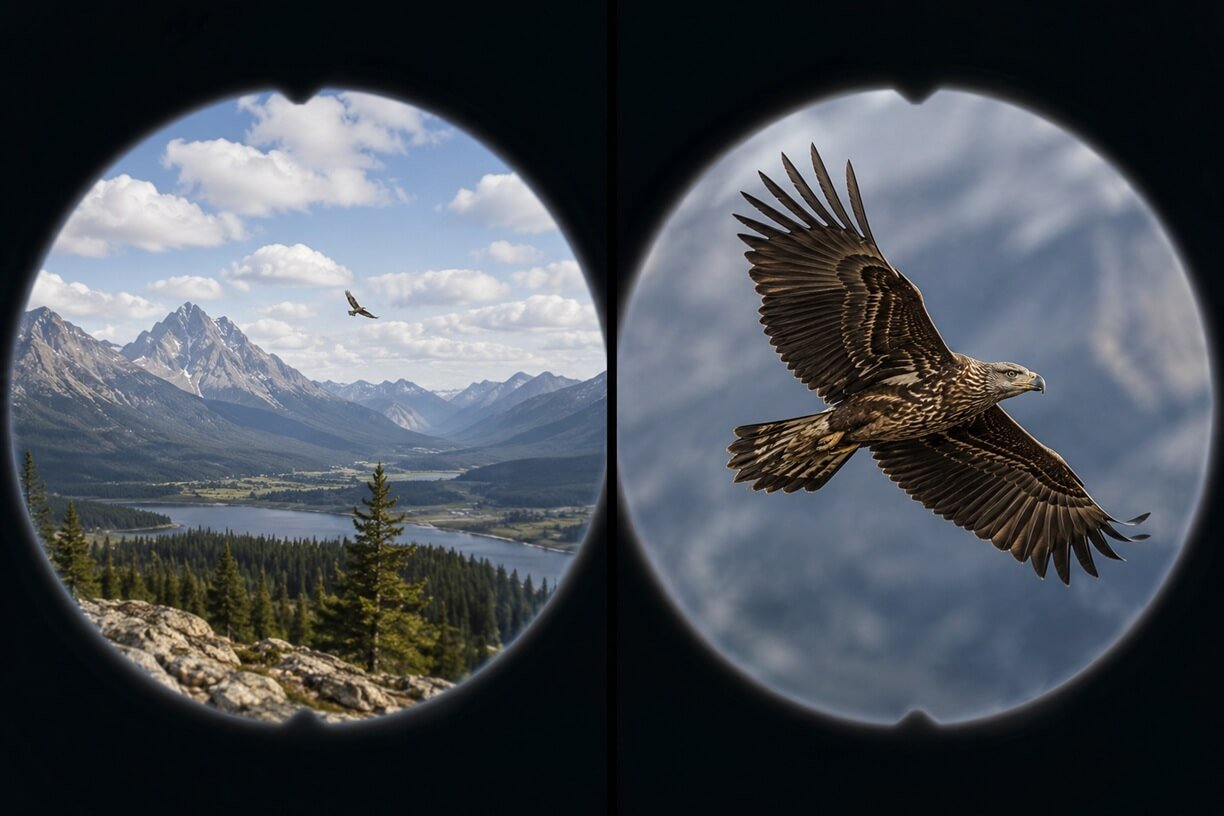
Field of view, or FOV, describes how much of the scene you can see through the optic. A wider field of view is especially useful for:
- Finding birds
- Tracking moving animals
- Scanning landscapes
- Watching sports
- Following wildlife
A narrower field of view can be acceptable when your subject is stationary, and you need maximum detail. Higher magnification generally reduces the field of view. Nikon notes that wider fields are advantageous when locating fast-moving birds or small objects.
Why FOV Matters in Real Life
Imagine you’re looking for a bird that keeps flying between branches. With a wide-field binocular, you have more surrounding area visible and can reacquire the bird quickly. With a high-powered, narrow-field optic, finding the bird can be much more difficult.
This is one reason experienced observers often use binoculars for locating a subject before switching to a spotting scope.
Eye Relief
Eye relief is the distance your eye can be from the eyepiece while still seeing the full image. This is especially important if you wear glasses. Longer eye relief generally makes an optic easier to use with eyeglasses. Fujifilm recommends looking for approximately 14 mm or more for glasses wearers.
When comparing binoculars or spotting scopes, don’t look at magnification alone.
Check:
- Eye relief
- Eyecup design
- Diopter adjustment
- Interpupillary adjustment
- Focus mechanism
A technically excellent optic is not very useful if you cannot comfortably see the entire field.
Close-Focus Distance
Close-focus distance is the shortest distance at which the optic can focus. A short close-focus distance can be useful for:
- Birdwatching
- Butterflies
- Insects
- Flowers
- Nature observation
For long-distance hunting, close focus is usually less important than:
- Optical resolution
- Contrast
- Low-light performance
- Field of view
- Durability
Understanding Optical Glass
The quality of the glass and optical design can have a major impact on image quality. You may encounter terms such as:
- Standard optical glass
- ED glass
- HD
- XD
- Fluorite
- APO
The terminology isn’t perfectly standardized across manufacturers. For example, Audubon notes that manufacturers may use different names such as HD, XD, or APO for low-dispersion optical designs.
What Is ED Glass?
ED stands for Extra-low Dispersion. The goal is to reduce chromatic aberration—the colored fringes that can appear around high-contrast objects.
High-quality low-dispersion optical systems can therefore produce cleaner edges and improved color correction, particularly at higher magnification. But don’t assume that the word “ED” alone guarantees excellent image quality. The complete optical system matters.
Lens Coatings
Optical surfaces can reflect some of the light that hits them. Coatings are used to improve light transmission and reduce unwanted reflections. You may encounter terms such as:
- Coated
- Fully coated
- Multi-coated
- Fully multi-coated
- Phase corrected
- Dielectric coated
These terms describe different aspects of optical construction. For roof-prism binoculars, phase-correction coatings can help maintain image quality by addressing phase shifts introduced by the prism system.
Dielectric prism coatings are used in many modern roof-prism designs to improve reflective performance. When comparing two optics, don’t judge them solely from a single marketing term. Look at the overall optical design, glass quality, coatings, mechanical construction, and actual viewing performance.
Roof Prism vs. Porro Prism Binoculars
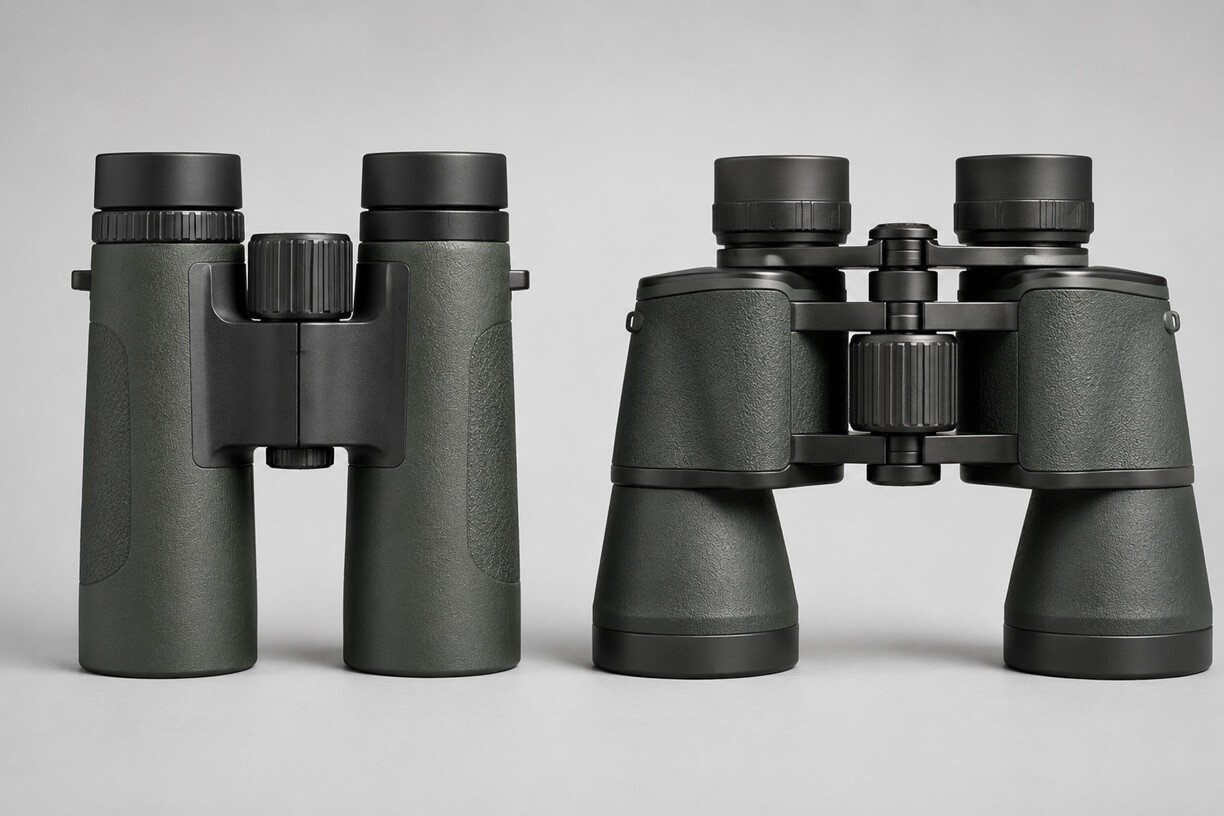
Binoculars generally use either a roof prism or Porro prism design.
Roof Prism
Roof-prism binoculars typically have a slimmer, more streamlined shape.
Advantages include:
- Compact design
- Easy handling
- Good ergonomics
- Excellent portability
They are extremely common in modern outdoor binoculars.
Porro Prism
Porro-prism binoculars have a more traditional stepped shape.
Advantages can include:
- Traditional optical design
- Strong depth perception
- Often good value
Their wider body can make them less compact than many roof-prism binoculars.
Which Should You Choose?
For hiking, hunting, travel, and general outdoor use, roof-prism binoculars are often the most practical choice. Porro-prism models can still be excellent if you prioritize their particular optical characteristics and don’t mind the larger body.
Angled vs. Straight Spotting Scopes
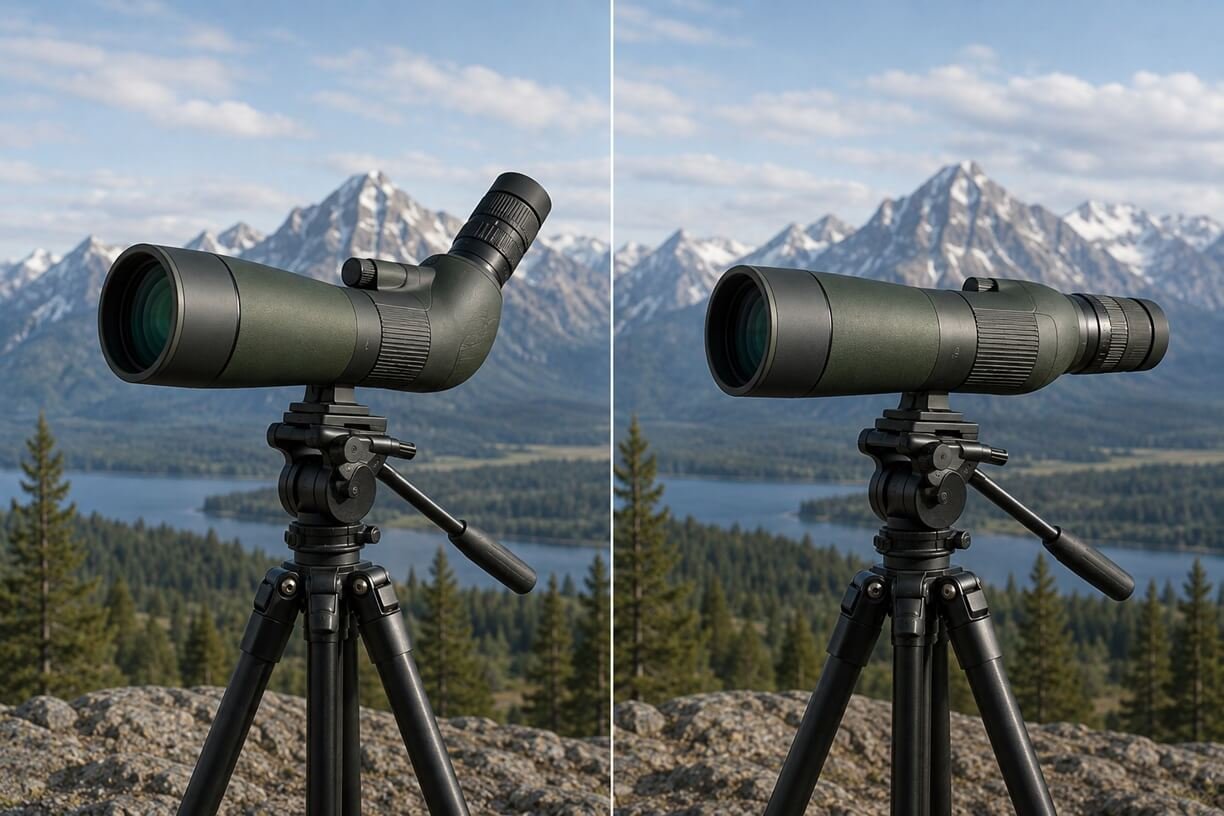
This is one of the most important spotting-scope decisions.
Straight Spotting Scopes
The eyepiece sits in line with the body.
Advantages:
- Intuitive target acquisition
- Easy to aim
- Familiar viewing angle
- Can be convenient for certain vehicle or concealment setups
Straight scopes can be particularly attractive to hunters who need to acquire a distant subject quickly.
Angled Spotting Scopes
The eyepiece is typically positioned around 45 degrees above the main optical axis.
Advantages:
- More comfortable for prolonged viewing
- Easier for people of different heights to share
- Can use a lower tripod
- Convenient for viewing upward
- Often easier to integrate into a comfortable seated setup
Celestron and Kowa both highlight the ergonomic and tripod-height advantages of angled scopes, while straight scopes can be more intuitive for quickly acquiring a subject.
Which Is Better?
Neither design is universally superior. Choose straight if rapid target acquisition and a familiar line-of-sight setup are priorities. Choose angled if comfort, shared viewing, and flexible tripod positioning matter more. For birdwatching and extended observation, angled scopes are often particularly comfortable.
Choosing the Right Spotting Scope Magnification
Common spotting-scope configurations include:
- 15–45×
- 20–60×
- 25–75×
The correct magnification depends on your application.
Lower Magnification
Useful for:
- Finding subjects
- Scanning
- Wider landscapes
- Moving wildlife
- Atmospheric conditions that limit high-power viewing
Higher Magnification
Useful for:
- Long-distance identification
- Reading distant detail
- Range shooting
- Detailed wildlife observation
- Distant bird identification
But maximum magnification isn’t always the best setting. Atmospheric haze, heat shimmer, wind, and vibration can make extremely high magnification frustrating. A quality scope at 30× may produce a more useful image than a poor scope pushed to 60×. Audubon similarly recommends prioritizing optical quality over simply chasing higher power.
Choosing the Right Spotting Scope Objective
Common objective sizes include approximately:
- 50–60 mm
- 65–70 mm
- 80–85 mm
- 95–100 mm
50–60 mm
Best when portability matters.
Good for:
- Hiking
- Backpacking
- Travel
- Mobile wildlife observation
65–70 mm
A useful middle ground between portability and light-gathering capability.
80–85 mm
Excellent for serious long-distance observation. The trade-off is greater size and weight.
95–100 mm
Designed for users who prioritize maximum light gathering and optical performance over portability. These larger scopes can become cumbersome for long approaches. Again, bigger isn’t automatically better.
Binoculars for Hunting
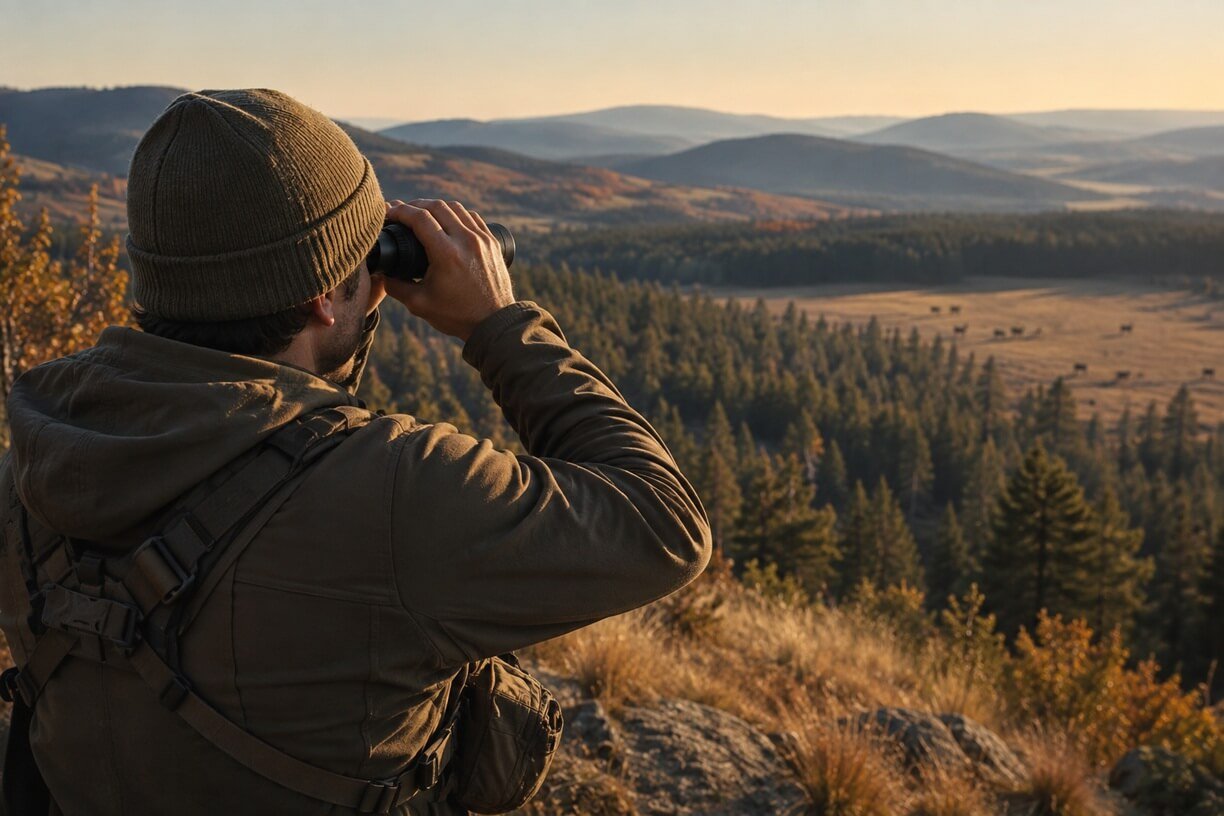
For many hunters, binoculars are the primary optic for locating and evaluating animals.
8×42
A strong all-around configuration.
Benefits:
- Stable
- Wide enough field of view
- Good low-light capability
- Manageable size
- Comfortable for long glassing sessions
10×42
A strong option for:
- Open country
- Longer observation distances
- Users who want more magnification
10×50
Useful when:
- Low-light performance matters
- Weight is less important
- You spend considerable time glassing
Spotting Scope for Hunting
Add a spotting scope when you frequently need to inspect distant animals or terrain in detail. A practical combination is:
Binoculars for searching + spotting scope for detailed confirmation.
Binoculars for Hiking & Backpacking
Weight matters much more when you’re carrying your optic for many hours. For backpacking, consider:
8×32
Excellent when you want:
- Low weight
- Compact size
- Good daytime performance
8×42
Better when:
- Low-light performance matters
- You don’t mind additional weight
- Wildlife observation is a major priority
A large 50 mm binocular provides more capability, but it can become an unnecessary burden on a long trail. For backpacking, the best optic is the one you’re actually willing to carry.
Binoculars for Birdwatching
Birdwatchers frequently prioritize:
- Wide field of view
- Good close focus
- Color accuracy
- Contrast
- Optical resolution
- Comfortable eye relief
An 8×42 is a highly versatile starting point. A 10×42 can be better for open habitats and distant birds. For very distant birds, a spotting scope can reveal details that binoculars simply cannot resolve at the same distance.
Spotting Scopes for Birdwatching
A spotting scope becomes particularly useful for:
- Shorebirds
- Raptors
- Waterfowl
- Distant seabirds
- Birds across lakes
- Wildlife in open habitats
The larger objective and higher magnification allow you to inspect subjects that are too distant for conventional binoculars.
However, atmospheric conditions can become a major limitation. Heat shimmer and haze can reduce the useful resolution of a high-powered scope. That’s why experienced birders don’t automatically use maximum magnification.
Spotting Scopes for Shooting Ranges
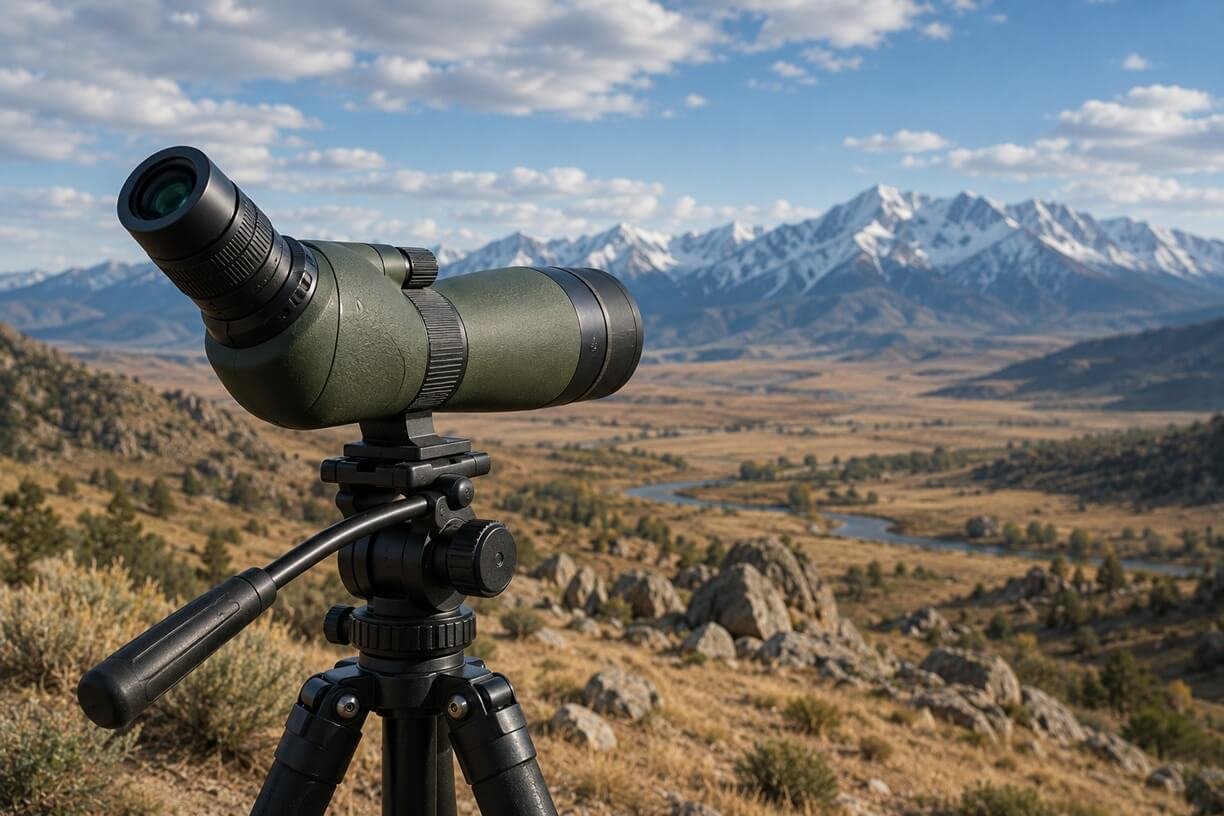
Spotting scopes are extremely useful for observing distant targets. Key considerations include:
- High-resolution optics
- Appropriate magnification
- Tripod stability
- Eye relief
- Image contrast
- Ability to resolve small details
- Performance in heat shimmer
A 20–60× scope can be versatile, but you may spend much of your time below maximum magnification. The most important feature is not the biggest number printed on the box. It’s whether the scope can produce a clean, usable image at the distances and conditions where you actually shoot.
Tripods: An Essential Spotting Scope Accessory
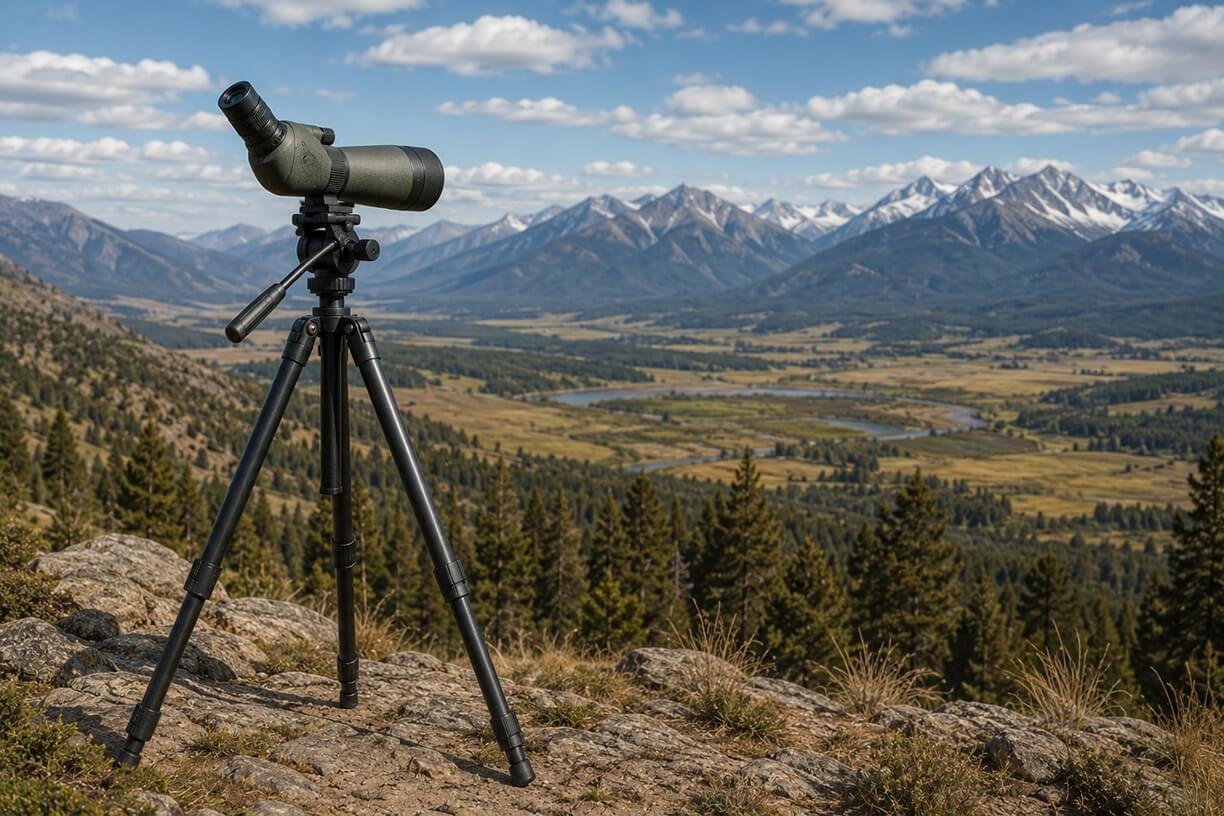
A spotting scope is only as useful as the support underneath it. At high magnification, tiny movements become highly visible. A tripod should provide:
- Adequate load capacity
- Good stability
- Smooth adjustments
- Appropriate height
- Compatibility with the scope
- Easy transport
A weak tripod can undermine an otherwise excellent spotting scope.
Aluminum vs. Carbon Fiber
Aluminum
Pros:
- Generally less expensive
- Durable
- Stable
Cons:
- Heavier
Carbon Fiber
Pros:
- Lighter
- Excellent for carrying
- Useful for backpacking
Cons:
- Usually more expensive
The best tripod is a balance between weight, stability, height, and portability.
Why Tripod Height Matters
Angled and straight spotting scopes behave differently on a tripod. A straight scope generally requires the eyepiece to be brought closer to eye level. An angled scope allows the tripod to remain lower while you look down into the eyepiece.
This can reduce the need for a very tall tripod and can improve stability because the tripod does not have to be extended as far. For long observation sessions, that ergonomic difference can become significant.
How to Use Binoculars Correctly
Even expensive binoculars can perform poorly if they’re incorrectly adjusted.
- Step 1: Adjust the Interpupillary Distance
- Step 2: Set the Eyecups
- Step 3: Focus the Main Focus
- Step 4: Adjust the Diopter
- Step 5: Recheck Focus
How to Use a Spotting Scope
A simple technique can make high-powered scopes much easier to use.
- 1. Start at Low Magnification
- 2. Center the Subject
- 3. Increase Magnification
- 4. Refocus
- 5. Reduce Magnification if Conditions Deteriorate
This “find first, zoom second” technique is especially important when observing moving wildlife.
Weather and Atmospheric Conditions
Your optic doesn’t operate in isolation. The atmosphere between you and your subject can become the limiting factor.
- Heat Shimmer: Hot air rising from the ground can create visible distortion. This is particularly noticeable at high magnification.
- Fog: Fog scatters light and reduces contrast.
- Rain: Rain can reduce visibility and create reflections and flare.
- Humidity: High humidity can reduce contrast over long distances.
- Haze: Haze can make distant objects appear washed out.
These conditions explain why simply increasing magnification doesn’t always reveal more detail. Sometimes the solution is to:
- Observe earlier or later
- Change your position
- Reduce magnification
- Wait for atmospheric conditions to improve
Waterproof and Fogproof Construction
Outdoor optics need protection from changing weather. Look for features such as:
- Waterproof construction
- O-ring sealing
- Nitrogen or other gas purging
- Durable exterior armor
Waterproofing protects against rain and moisture. Fogproof construction helps prevent internal condensation when temperatures change. These features are particularly important for:
- Hunters
- Hikers
- Birdwatchers
- Boaters
- Mountain users
- Travelers
How to Clean Binoculars and Spotting Scopes
Dust and fingerprints can reduce image quality and potentially damage optical coatings if handled incorrectly.
Basic Cleaning Procedure
- Remove loose dust first.
- Use a proper lens-cleaning tool.
- Apply appropriate optical cleaning solution when necessary.
- Use a clean microfiber or manufacturer-approved lens cloth.
- Avoid rubbing aggressively.
- Keep the protective caps on when the optic isn’t being used.
Never wipe gritty or dusty glass aggressively. Loose particles can scratch optical surfaces. Also avoid household glass cleaners unless the manufacturer specifically says they’re safe.
Common Binocular Buying Mistakes
- Mistake 1: Buying the Highest Magnification
- Mistake 2: Ignoring Weight
- Mistake 3: Looking Only at Objective Size
- Mistake 4: Ignoring Eye Relief
- Mistake 5: Ignoring Field of View
- Mistake 6: Choosing Based Only on Marketing Terms
- Mistake 7: Forgetting Waterproofing
Common Spotting Scope Buying Mistakes
- Buying Too Much Magnification
- Choosing an Oversized Scope for Backpacking
- Using a Cheap Tripod
- Ignoring the Eyepiece
- Choosing Straight vs. Angled Without Considering Your Use
How Much Should You Spend?
There is no universal price point at which binoculars or spotting scopes suddenly become “good.” As you move into better optics, you’ll gain improvements in:
- Optical clarity
- Contrast
- Color correction
- Edge performance
- Low-light performance
- Mechanical quality
- Focus precision
- Waterproofing
- Durability
But the most expensive optic isn’t automatically the best choice for every user. For example, a lightweight mid-range 8×32 may be a better purchase for a backpacker than a massive premium 10×50. Likewise, a compact 60–65 mm spotting scope can be more practical for a mobile birder than a much larger 95–100 mm model.
Buy for your use case, not for the specification sheet alone.
Binoculars or Spotting Scope: Which Should You Buy?
Use this simple decision framework.
Choose binoculars if:
- You hike frequently.
- You need lightweight gear.
- You observe moving wildlife.
- You scan large areas.
- You want handheld operation.
- You travel frequently.
- You primarily observe during daylight.
Choose a spotting scope if:
- You need substantially higher magnification.
- You regularly observe very distant subjects.
- You need to inspect fine details.
- You spend significant time stationary.
- You don’t mind carrying a tripod.
- You shoot at long range.
- You frequently observe distant birds or wildlife.
Choose both if:
You regularly hunt, birdwatch, or observe wildlife at long distances. This combination is particularly powerful:
Binoculars → Locate → Spotting Scope → Inspect
Best Binocular Configurations by Activity
| Activity | Recommended Starting Point | Why |
| Hiking | 8×32 | Lightweight and compact |
| Backpacking | 8×32 | Low carrying weight |
| General outdoor use | 8×42 | Excellent balance |
| Hunting | 8×42 or 10×42 | Versatile field performance |
| Open-country hunting | 10×42 | Additional reach |
| Low-light observation | 10×50 | Larger objective |
| Birdwatching | 8×42 or 10×42 | Good balance of FOV and reach |
| Travel | 8×32 | Compact |
| Astronomy | 10×50 or larger | Larger objective and reach |
| Marine use | 7×50 | Stability and large exit pupil |
These are starting points rather than universal rules. Your terrain, lighting, eyesight, and carrying preferences should ultimately determine the choice.
Best Spotting Scope Configurations by Activity
| Activity | Useful Configuration | Main Priority |
| Backpacking | 50–65 mm | Weight |
| Birdwatching | 60–85 mm | Resolution and FOV |
| Hunting | 60–85 mm | Reach vs. portability |
| Long-range observation | 80–100 mm | Optical performance |
| Range shooting | 60–85 mm | Resolution |
| Digiscoping | 65–95 mm | Optical quality and compatibility |
| Travel | 50–65 mm | Compact size |
There is no single best spotting scope configuration for everyone.
The Best Way to Choose Your Optic
Instead of starting with a product, start with your activity.
- Step 1: Identify the Main Use
- Step 2: Determine Typical Distance
- Step 3: Decide How Much Weight You Can Carry
- Step 4: Choose a Practical Magnification
- Step 5: Choose the Objective Size
- Step 6: Evaluate Optical Quality
- Step 7: Check Ergonomics
- Step 8: Consider Weather Protection
- Step 9: Don’t Forget the Support System
- Step 10: Consider the Entire System
It’s the one that provides the right performance without creating compromises you don’t want to live with.
Frequently Asked Questions About Binoculars & Spotting Scopes
Can binoculars damage your eyes if you look at the sun?
Yes. Never look directly at the sun through binoculars or a spotting scope. The optics concentrate sunlight and can cause severe, permanent eye damage. Solar observation requires equipment specifically designed and certified for safe solar viewing.
Can you use binoculars in the rain?
Yes, provided the binoculars are designed for wet-weather use. Waterproof construction is preferable for hiking, hunting, boating, and other outdoor activities. Even waterproof binoculars should be dried and stored properly after prolonged exposure to rain.
Can binoculars be used without adjusting the diopter?
They can produce an image without adjustment, but the view may not be equally sharp for both eyes. Correctly setting the diopter compensates for differences between your eyes and allows the binoculars to focus properly.
Why do some binoculars have different focus mechanisms?
Binoculars commonly use central focusing, individual eyepiece focusing, or fixed-focus systems. Central focusing is versatile for wildlife and birdwatching, while individual-focus designs can be useful for applications where subjects are generally at longer distances.
Why do binoculars sometimes show a double image?
A double image can occur when the two optical paths are no longer properly aligned. This condition, known as collimation error, can result from impact, manufacturing problems, or damage. If adjusting the normal focus and diopter does not solve it, professional servicing may be necessary.
Why does my spotting scope look blurry even though the lens is clean?
Blur isn’t always caused by dirty glass. Possible causes include incorrect focus, atmospheric turbulence, vibration, heat shimmer, poor tripod stability, or pushing the scope beyond its useful magnification in current conditions.
Why does a spotting scope look clearer at 30× than at 60×?
Higher magnification magnifies everything, including atmospheric distortion and vibration. If the air is turbulent or the support isn’t sufficiently stable, reducing magnification can produce a sharper and more useful image.
Can you leave binoculars in a hot car?
It’s better to avoid prolonged exposure to extreme heat. High temperatures can affect lubricants, seals, adhesives, coatings, and internal components. Store optics somewhere cool and dry whenever possible.
How should binoculars be stored between trips?
Store them in a dry, reasonably temperature-controlled environment with the objective and eyepiece caps installed. Avoid leaving optics damp inside a sealed case because trapped moisture can encourage fungal growth or other damage.
Can you use a spotting scope through a vehicle window?
Yes, but vibration can become a major problem. A stable mount and suitable window or vehicle support can help, but the best results usually come from a solid setup that minimizes movement.
Is a zoom spotting scope always better than a fixed-magnification scope?
Not necessarily. Zoom scopes provide flexibility because you can change magnification without changing eyepieces. Fixed-magnification systems can offer advantages in simplicity and, depending on the design, optical performance. The better choice depends on whether flexibility or specialized performance matters more to you.
Can you share one spotting scope between several people?
Yes. An angled spotting scope can be particularly convenient when several people of different heights need to observe the same subject. The tripod and viewing position can often remain comfortable without major adjustments between users.
Is a larger spotting scope always better for long-distance viewing?
No. A larger objective can provide advantages, but it also increases weight and bulk. Atmospheric conditions can also become the limiting factor before the larger objective provides a meaningful benefit. For mobile users, a smaller scope that gets carried and used regularly can be more valuable than a much larger scope left at home.
When should you upgrade your binoculars or spotting scope?
Consider upgrading when your current optic has a specific limitation that affects your use, such as insufficient low-light performance, inadequate resolution, poor ergonomics, excessive weight, limited weather protection, or insufficient magnification. Upgrading simply because a newer model exists isn’t necessarily worthwhile.
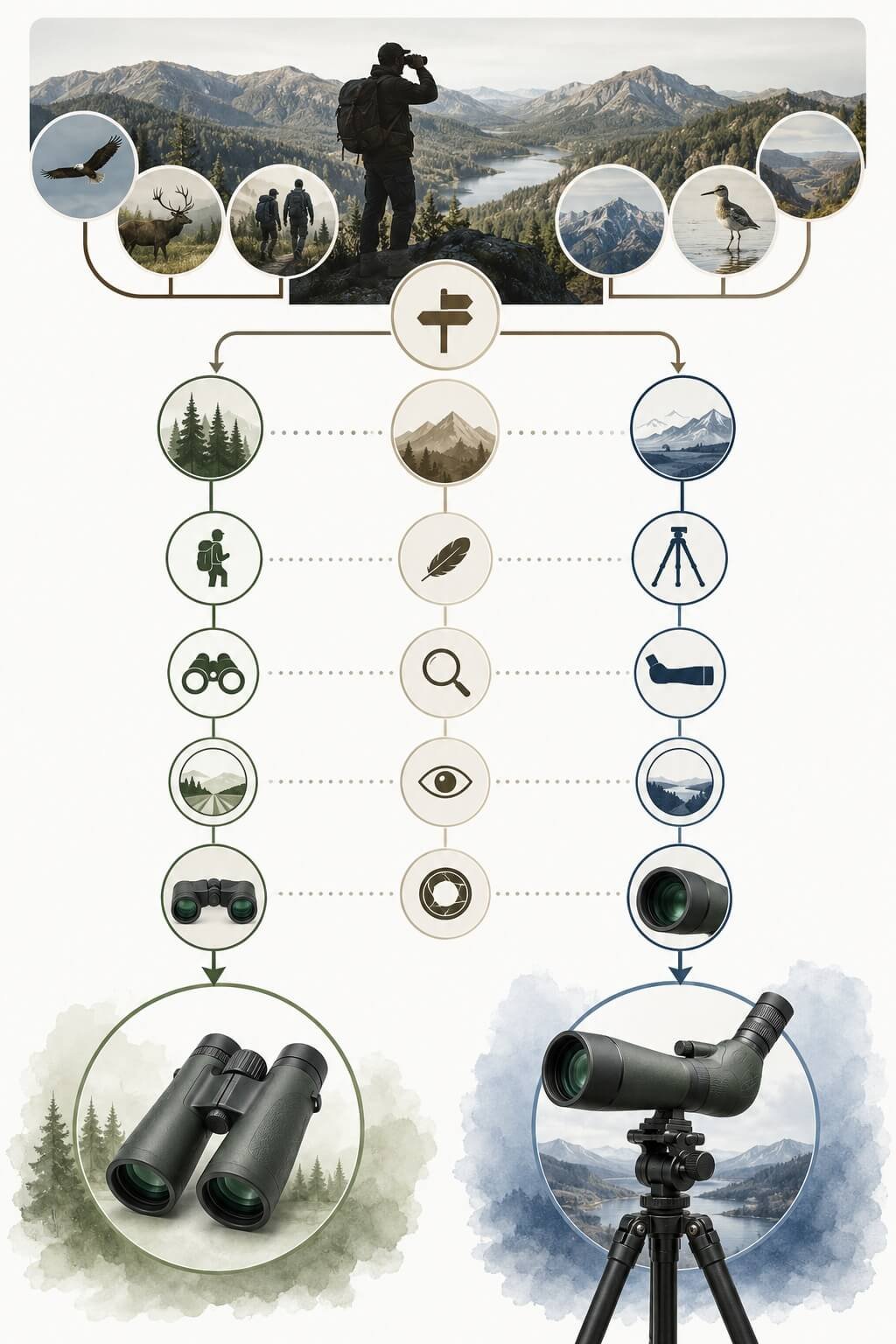
Final Verdict
The right binoculars or spotting scope depends less on the biggest numbers and more on how you intend to use the optic. For most outdoor users, 8×42 binoculars provide an excellent balance of magnification, field of view, brightness, stability, and portability. If you need more reach, 10×42 binoculars are a strong alternative.
For serious long-distance observation, a spotting scope in the 15–45×, 20–60×, or similar range can provide dramatically more magnification, but you’ll need a stable tripod and should expect additional weight. For extended observation and shared use, an angled spotting scope is often particularly comfortable. For rapid target acquisition or certain hunting setups, a straight scope can make more sense.
Most importantly, don’t buy optics based solely on magnification, objective size, or marketing labels. Think about the complete system:
Magnification + objective size + optical quality + field of view + eye relief + weight + stability + weather protection + your actual use case.